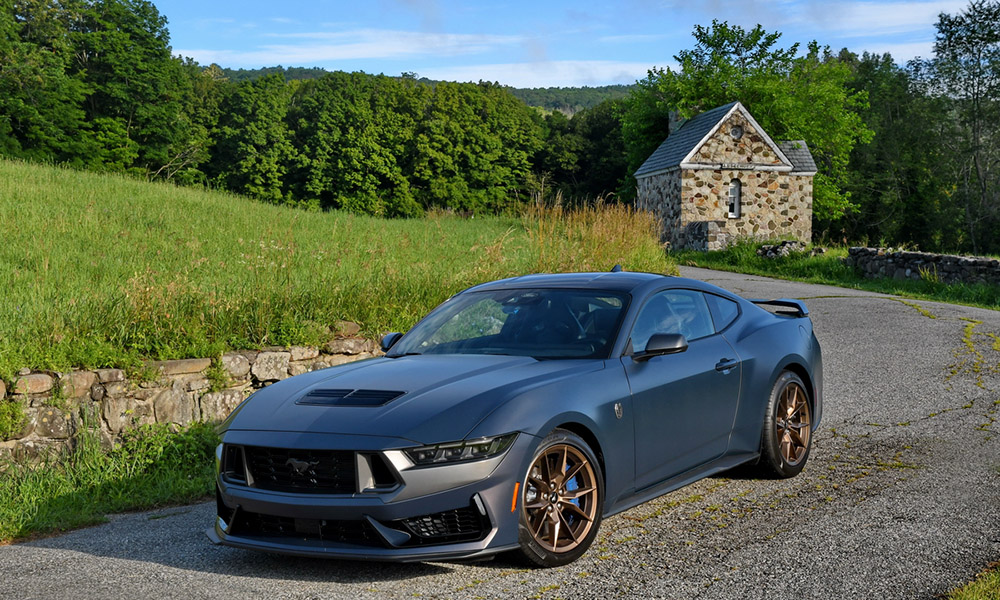
Photo: David Haueter
The Mustang is the only car that Ford now has in their U.S. model lineup, which is dominated by SUVs and trucks.
Thankfully, Ford has gone all-in on its two-door sports car that has such a strong brand heritage. It offers nine different coupe and convertible variations of the Mustang, as well as three race versions, including the Mustang Dark Horse R, Mustang GT4 and Mustang GT3.
Ford offers a few different engine choices for the Mustang street cars. The base model Mustang is fitted with a 2.3-liter turbocharged four-cylinder that puts out a respectable 315 horsepower and 350 foot-pounds of torque.
The Mustang GT models feature a 5.0-liter V8 that puts out 480 hp and 415 lb.-ft. of torque, and then there’s the Mustang Dark Horse featured here that uses the same engine as the GT but is tuned to raise output to 500 hp and 418 lb.-ft. of torque.
The Dark Horse R used in the IMSA-sanctioned Mustang Challenge series is a race-prepared version of the Dark Horse street car.
The Dark Horse has a lot of work done to get to 500 hp besides a simple software tune, including a stronger forged crankshaft and connecting rods, upgraded camshafts, and larger cold-air intakes.
To handle the extra heat the car may generate at track days, the Dark Horse has a more effective oil cooler as well as a more efficient and lighter radiator.
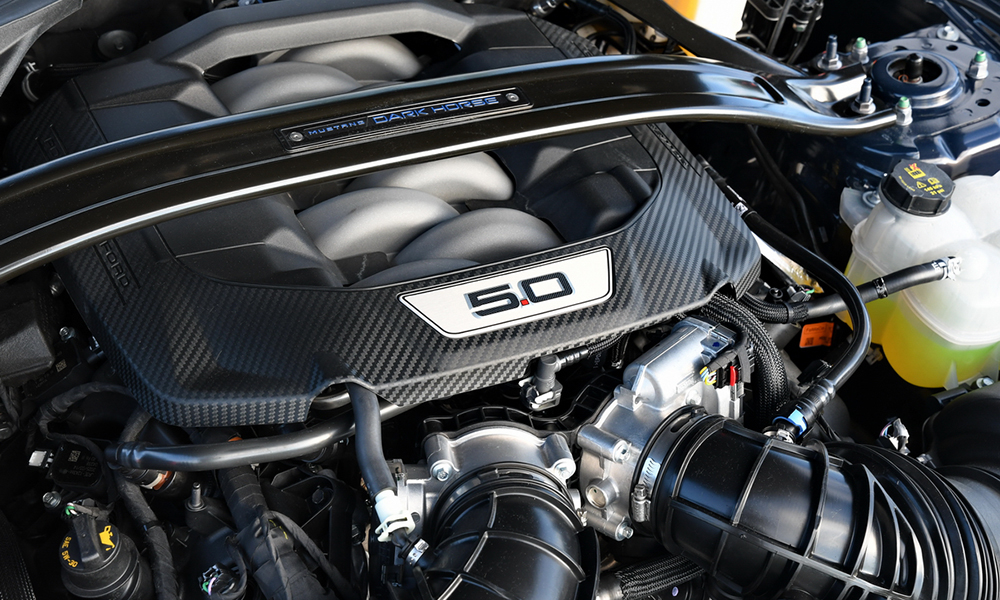
Photo: David Haueter
Performance upgrades to the Dark Horse extend beyond the engine. The car rides on Ford’s MagneRide hydraulic dampers and has a stiffer suspension tune with larger anti-roll bars, as well as a strut tower and K-braces to reduce chassis flexing.
An optional Handling Package ($5,495) goes a step further, with more aggressive chassis tuning, more aero and adjustable struts that allow camber adjustment.
The Dark Horse can be had with either a TREMEC six-speed manual transmission, or a ten-speed automatic. There’s a 3.55 Torsen limited slip differential (LSD) with a dedicated cooler for the automatic-equipped model, or a 3.73 LSD if you opt for the manual.
Braking is improved with large 15.4-inch Brembo brakes with six-piston calipers at the front and 14-inch rotors with four-piston calipers at the rear. Our test car wore Pirelli P Zero tires.
The Dark Horse looks a bit different than the Mustang GT, with bigger air intakes and a more aggressive front splitter, a rear wing mounted to the trunk (though you can get a rear wing option on the GT), a hood stripe and different wheels.
Another key cosmetic feature of the Dark Horse is black accents under the headlights that I assume were added to differentiate the car from the GT but don’t serve any purpose.
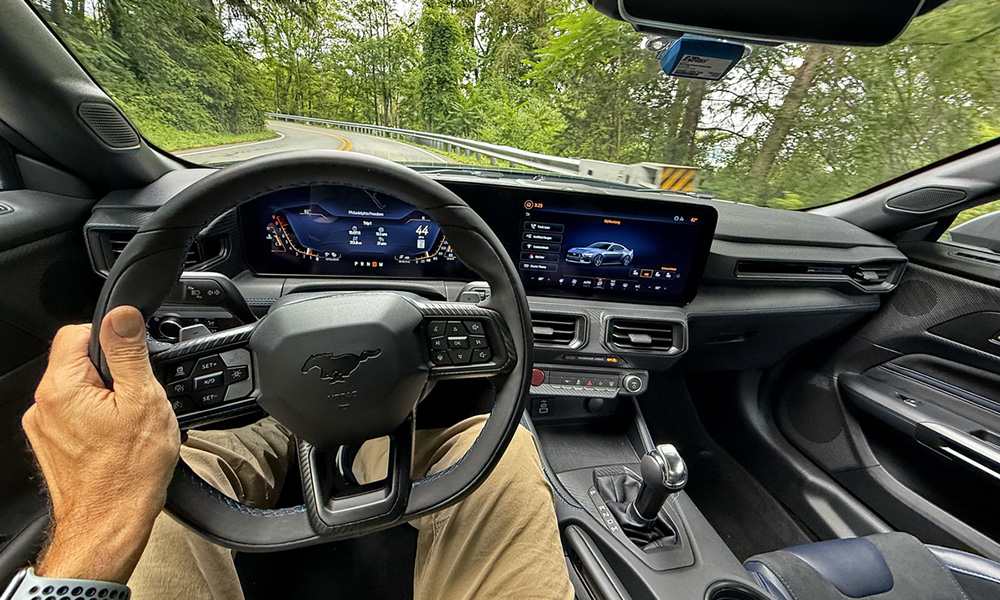
Photo: David Haueter
Inside, the Dark Horse and GT are almost identical, but the Dark Horse does have some different trim on the steering wheel and doors.
Both models use a large center display for most of the car’s functions and electronic gauges. One thing I found cool with the gauge display is that there are options to make them look like the classic 1960’s Mustang or the Fox-body model from the 1980’s and early ‘90’s. Both the GT and Dark Horse models have Recaro seats.
The new Mustang Dark Horse is still all about the American muscle car vibe. Yes, there’s the fancy new electronic displays and all that, but this car still has a big V8 under the hood and still looks, feels and sounds like a Mustang should.
Our test car was equipped with the automatic transmission, and while it did have paddle shifters on the wheel, it also had an old school upright transmission lever and a nice big handle to pull up the emergency brake, though the brake itself is electronic.
Drivers can choose from Normal, Comfort and Sport driving modes (which are customizable for throttle, suspension and steering), as well as choose from four exhaust sound levels.
The exhaust levels are all on the loud side compared to other cars, but the lowest level won’t annoy your neighbors as much. Changing the driving modes seems to impact the suspension stiffness more than the throttle or steering response.
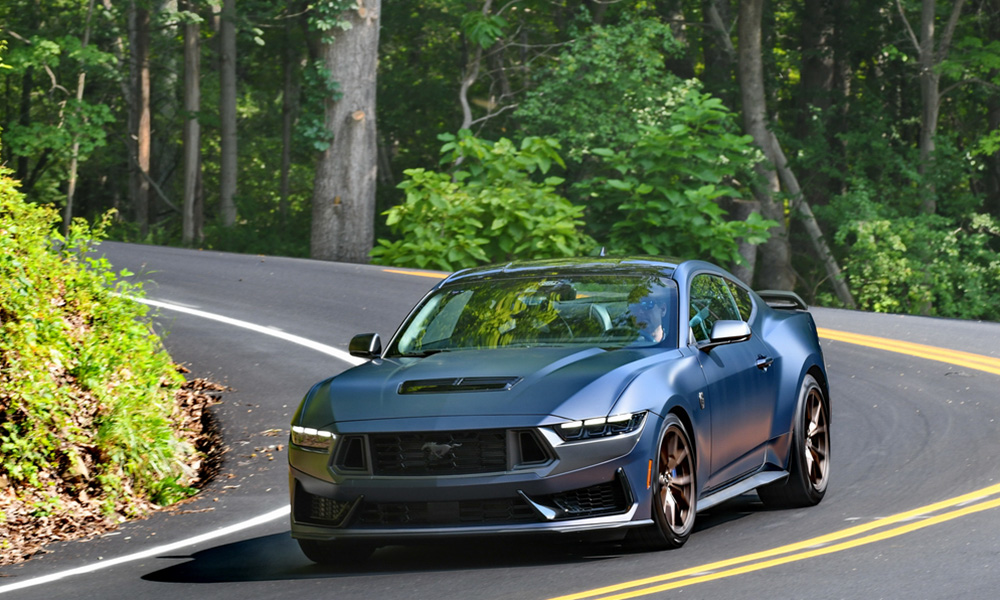
Photo: David Haueter
Behind the wheel, the Dark Horse feels like a proper sports coupe and it’s a genuinely fun car to drive on a twisty back road. The Dark Horse is a heavy car, but the MagneRide dampers and suspension tuning do a great job of controlling the weight and making it responsive to steering inputs.
The engine is responsive and powerful, with prodigious torque when exiting corners. It’s also very quick from a standstill, with Motor Trend reporting a 3.7-second 0-60 time with the automatic (4.1 seconds with the manual).
The automatic transmission is well-suited to the engine, but it’s more fun to manually shift with the paddles then let the car shift for you, as it usually wants to shift into a higher gear before you would like.
The brakes in this car are also very impressive, with a high and hard pedal that allows the Dark Horse to scrub off speed or come to a stop in much shorter distances than you may expect.
They feel like they would last all day without fading on a race track. The Recaro seats are comfortable yet supportive. If there’s one area where the Dark Horse could be more dynamic, it’s the steering.
As with many cars these days, there’s not much feel through the steering wheel itself, though the steering is responsive and precise.
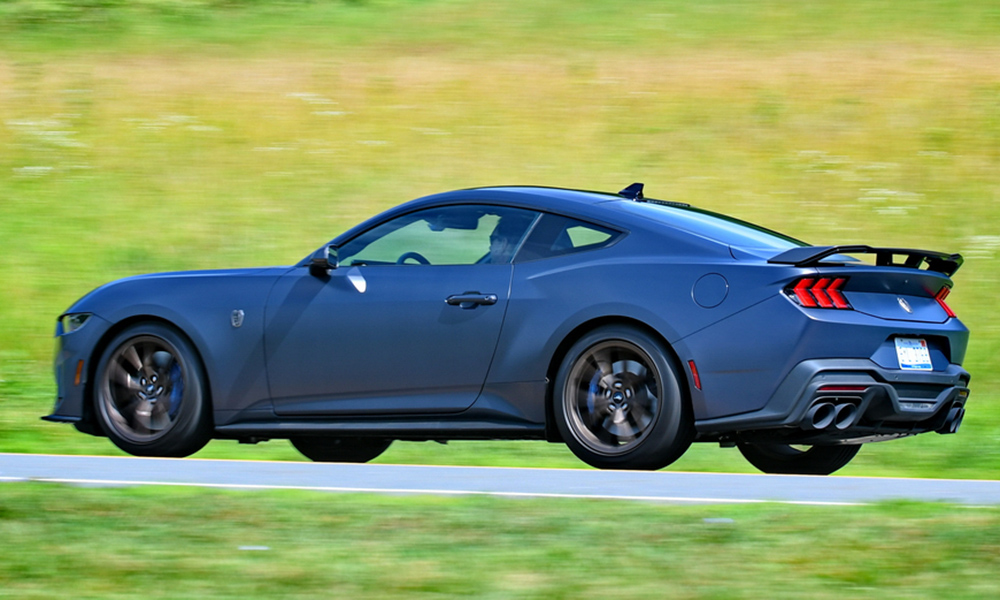
Photo: David Haueter
With a starting price of $64,080, the Mustang Dark Horse is a relative bargain compared to other sports coupes with this level of performance. It doesn’t feel as well put together as the BMW M2 that we recently reviewed ($68,200), but the performance of the Dark Horse in on par with the BMW, and like the M2, it’s completely usable as a daily driver.
That being said, we don’t think many buyers will be deciding between a BMW M2 and a Ford Mustang Dark Horse.
The biggest competitor to the Dark Horse may actually be the Mustang GT. It has nearly the same horsepower and if you choose the right options it can get pretty close in performance to the Dark Horse at a lower price.
For instance, a Mustang GT Fastback starts at $46,560 but can be had with the optional GT Performance Package ($5,660) that adds items such as Brembo brakes, stiffer suspension bits and the same limited slip differential that’s in the Dark Horse.
Deciding between the two may come down to which model you think looks better or whether you plan to attend track days or autocrosses with the car.
I’d choose the Dark Horse if I planned frequent track events but would probably take a close look at the GT if my driving plans were limited to the street.



GT World Challenge America
Wright Reveals ‘Electric Dory’ Porsche 911 GT3 R Evo Livery

GT World Challenge America
SRO America Launches New RaceControl Multiviewer

WeatherTech Championship
Mustang Sampling Returns to JDC-Miller for Rest of Season

Lamborghini Super Trofeo NA
Chambers, Calderon in Two-Car RAFA Super Trofeo Squad

Ferrari Challenge NA
Thermal Club Set for Season Kickoff This Weekend

Intercontinental GT Challenge
Konrad Secures Lamborghini Support for Huracan N24 Entry


Lamborghini Super Trofeo
Lamborghini Has “Ambition” for All-Temerario Grids in 2027

WeatherTech Championship
Vosse: Daytona Podium “Big Boost” for WRT’s IMSA Foray


WeatherTech Championship
Listen to In-Car Audio from Valkyrie at Daytona

Porsche Carrera Cup NA
Drivers Give Early Impressions of New Porsche 911 Cup

Michelin Pilot Challenge
Introducing IMSA’s Latest 3D Scholarship Winner Nicky Hays

WeatherTech Championship
Watch the Rolex 24 Sights & Sounds