Photo: Javier Jimenez/DPPI
IMSA President John Doonan said he’s still hopeful of a common set of top-class technical regulations for 2030 but admitted “we’ve got a lot of work to do” with the “devil in the details.”
The FIA, ACO and IMSA, along with current and future LMDh and LMH manufacturers have continued to discuss plans for a unified set of regulations that would eliminate the disparity between the two current platforms.
The collective goal has been to announce details of the ruleset at this year’s 24 Hours of Le Mans.
“We had an awesome meeting last September in Paris with all of the manufacturers, the ACO and the FIA,” said Doonan.
“I left that room with a lot of energy about maybe taking another step where we bring together the two different sets of technical regulations and try to, for 2030, as a target, to have one set of technical regulations.
“There’s going to be a lot of work needed to be done between now and announcing that.
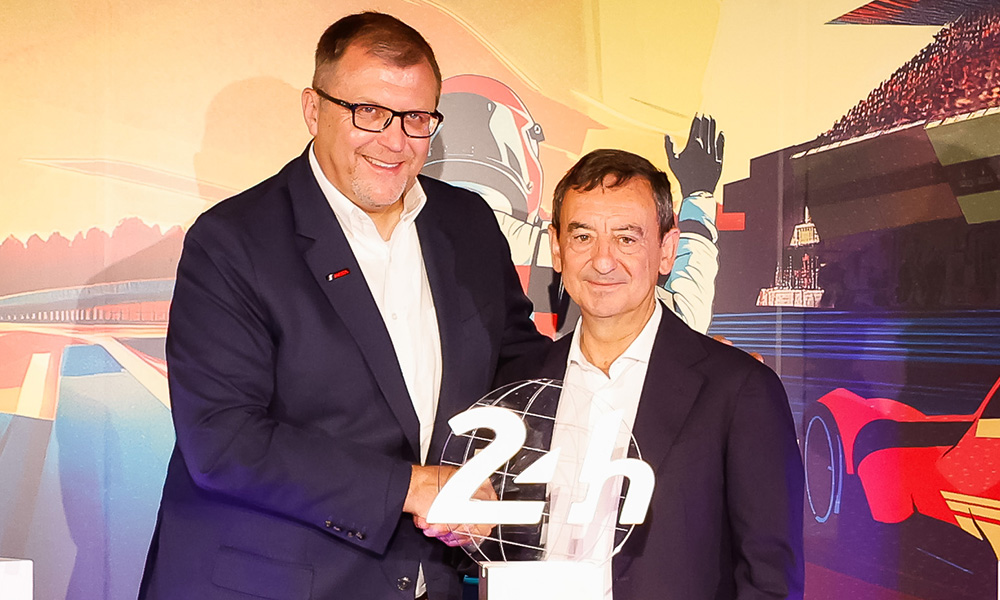
“Based on our annual steering committee meeting with Pierre [Fillion, ACO President], Frederic [Lequien, LMEM boss] and Thierry Bouvet [ACO competition director], Simon Hodgson [IMSA VP of competition], Ed [Bennett, IMSA CEO] and Jim [France, IMSA chairman] on my side, it was a lot of that same discussion about wanting to achieve that.”
When asked by Sportscar365 if IMSA is fully aligned and in lock-step with the FIA and ACO on the single-platform vision, Doonan fell short of confirming the sanctioning body’s position at this time.
“The devil is in the details,” he said. “What’s the aero box? There’s so much that needs to be defined by the technical leads. But I think that is exactly where we’d like to end up.
“I think in general, that’s the vision (to be in lock-step with FIA/ACO). Again, no public statements. We want to do that jointly as part of our partnership.
“But I’d say the atmosphere in the room is definitely one of trying to achieve that for the good of the sport.”
With the current set of LMDh/LMH regs, which form the basis of the WEC Hypercar and IMSA GTP classes, confirmed through the end of the 2029 seasons, Doonan said he’s hopeful of having clarity on 2030 as soon as possible.
“I think as soon as humanly possible because the manufacturers have to plan,” he said. “There’s a development cycle, a design cycle that we need to give them as much runway.
“Where we are today is because of the runway we gave in January 2020. That momentum has carried on and I hope that by getting it out as early as we can that will get us there.
“We came out of September [with] a direction to have one set of regulations. But we’ve got a lot of work to do.”



GT World Challenge America
No. 88 Kellymoss Porsche Withdrawn After Testing Crash

GT World Challenge America
Scott Dollahite in Team Manager Role as Part of “Long Term” Plan

Pirelli GT4 America
Neugebauer ‘Chasing New Challenge’ With RAFA, Toyota

GT World Challenge America
Porsche: SRO America “Perfect Showcase” for Rising Talent

Intercontinental GT Challenge
Vanthoor, Heinrich Join Lionspeed GP for N24

Mustang Cup Australia
Le Mans Invite Winner McLeod Confirmed for Phillip Island


Nürburgring Endurance
Verstappen Mercedes-AMG Disqualified for Tire Rules Breach

WeatherTech Championship
Estre Accuses Nasr of Violating Porsche Penske Team Orders

WeatherTech Championship
No. 10 WTR Cadillac Loses Sebring Podium Finish

WeatherTech Championship
Porsche Penske Unveils Mobil 1 Liveries for Sebring


Porsche Carrera Cup NA
Watch Full-Length Replays of Rounds 1 & 2 at Sebring

Lamborghini Super Trofeo NA
Watch Full-Length Replays of Rounds 1 & 2 at Sebring

Mustang Challenge NA
Watch Full-Length Replays of Rounds 1 & 2 at Sebring

Porsche Carrera Cup NA
Inside the Germany to Sebring Journey for Porsche 911 Cup

Michelin Pilot Challenge
Watch the Full-Length Replay of Sebring 120