Photo: Jake Galstad/IMSA
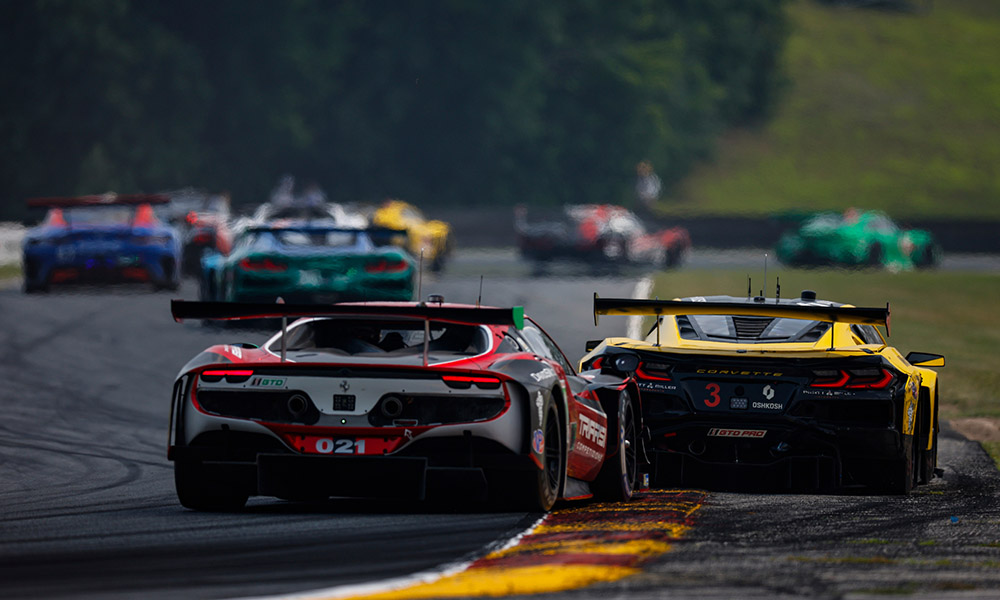
IMSA has made wholesale power level adjustments to every GT3-spec car ahead of next weekend’s Michelin GT Challenge at Virginia International Raceway.
Released on Thursday in the sanctioning body’s Balance of Performance document, each of the nine eligible GT3 models have received power increases or decreases across the two-stage system.
Additionally, the BMW M4 GT3 EVO has received a 16 kg increase in minimum weight, with the Chevrolet Corvette Z06 GT3.R getting a 7 kg reduction.
Among the notable changes include a 4.3 percent increase in power, across both first and second stages, for the Ford Mustang GT3, a 4.5 percent increase in Stage 1 power for the Lexus RC F GT3, and a 5.6 percent increase in Stage 2 power for the Lamborghini Huracan GT3 EVO2.
The single-biggest change is with the BMW, which gets a 7.6 percent increase in second-stage power.
While the majority of the cars have received power increases, both the Lamborghini (-0.5 percent) and Mercedes-AMG GT3 Evo (-0.9 percent) have received slight power cuts at Stage 1, while reductions have been made at the second stage to the Corvette (-1 percent), all when compared to the last race at Road America.
The threshold between first and second stages remain at 190 km/h and 200 km/h, respectively.
“The goal of IMSA’s Balance of Performance process for GTD and GTD Pro is to maintain performance parity between the fastest GT3 entries across all circuits and race lengths,” a statement from the IMSA technical committee read.
“The unique variety in GT3 machinery—from aerodynamics and bodywork to engine design and placement—produces performance differences that vary from track to track, so the IMSA Technical Committee’s BoP process has been constructed to adjust for these influences by leveraging a common set of tools including torque sensors, wind tunnel data, and simulations.
“Encapsulated in the BoP process are structured calculations that adjust for trends in demonstrated performance over the most recent events.
“However, the track-to-track influences are significant for GT3 cars and tend to account for the majority of adjustments listed in IMSA’s BoP tables.
“IMSA continues to engage on all BoP matters with IMSA’s manufacturer partners in regularly scheduled open forum discussions.
“These meetings continue to provide our manufacturers with the opportunity to critique the process and provide additional feedback, all of which helps develop and improve the BoP processes.
“This in turn helps to keep our joint customers informed, ensuring IMSA’s administration of the process is transparent.”




WeatherTech Championship
Pfaff Confirms Temerario GT3 Entry for Long Beach With Vanier

Nürburgring Endurance
BMW Expecting M3 Touring 24H to Fight With SP9 GT3 Cars


Porsche Sprint Challenge NA
Staut, Koch Shine in Barber Sprint Challenge Weekend

Mustang Cup USA
Buhl, Adams Score Victories in Capaldi Sweep at Barber


Nürburgring Endurance
Verstappen Mercedes-AMG Disqualified for Tire Rules Breach

WeatherTech Championship
Estre Accuses Nasr of Violating Porsche Penske Team Orders

WeatherTech Championship
No. 10 WTR Cadillac Loses Sebring Podium Finish

Nürburgring Endurance
Verstappen Wins NLS2 by One Minute on Mercedes-AMG Debut

Asian Le Mans Series
Porsche Projecting Possibility of “Two to Four” 963s for Asia

WeatherTech Championship
Watch the Full-Length Replay of 12H Sebring

Porsche Carrera Cup NA
Watch Full-Length Replays of Rounds 1 & 2 at Sebring

Lamborghini Super Trofeo NA
Watch Full-Length Replays of Rounds 1 & 2 at Sebring

Mustang Challenge NA
Watch Full-Length Replays of Rounds 1 & 2 at Sebring

Porsche Carrera Cup NA
Inside the Germany to Sebring Journey for Porsche 911 Cup