Photo: Fabrizio Boldoni/DPPI
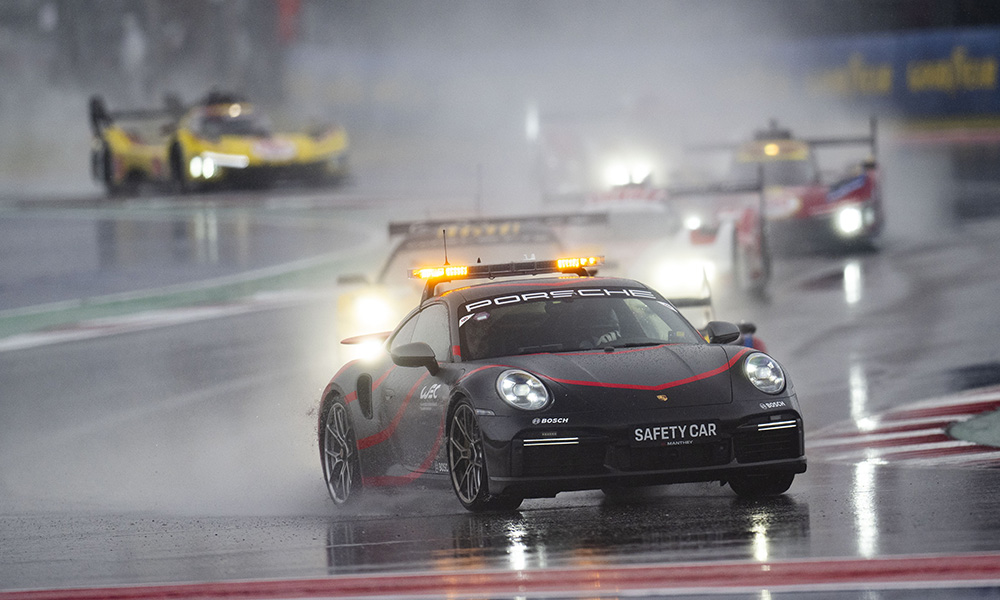
Numerous FIA World Endurance Championship drivers have remarked on the extreme conditions in Sunday’s Lone Star Le Mans at the Circuit of The Americas, with pole-sitter Phil Hanson describing the amount of aquaplaning as “crazy.”
The sixth round of the WEC season was marked by heavy rain through much of the six-hour duration, with the rain only easing and the conditions improving in the final stages.
Drivers therefore had to deal with the twin challenges of poor visibility amid the spray and surface water gathering at various points on the track surface.
AF Corse Ferrari driver Hanson, who led behind the safety car and then when the race went green in the first hour before being red-flagged, said he was surprised how early the field was released in the poor conditions, and expressed his displeasure with the lack of notice before the safety car lights went out.
Hanson said post-race: “You saw people aquaplaning. It was f***ing crazy.
“In the early stages two cars crashed, and in my opinion the aquaplaning in those areas got worse, and then we went green after the second safety car.
“For me it was very surprising. There was very little time to know we were going back to green. I was the leader, and normally you have a big heads-up and a lot of opportunity to warm up the car, and both times the car was stone cold.
“I was only aware the safety car was coming in in the third sector. We were just cruising, saving fuel, and we had 20 degrees [Celsius] on the brakes, no tire pressure, no tire temperature. That was tough.”
Hypercars spinning were a frequent sight throughout the race, although those cars that failed to finish did so due to reliability issues rather than accidents.
Among those to struggle the most was Raffaele Marciello in the No. 15 BMW M Hybrid V8, who suffered multiple pirouettes as he struggled for grip, and the Italian driver felt the conditions were close to being over the limit of being safe.
“I think we were struggling more than the others,” said Marciello. “We were three to four seconds off the pace almost all race, so it was almost undriveable.
“The [lack of] visibility for me was way too much, but even for a GT driver, we were doing the straights at 150, 160 km/h because you were not able to see in front.
“It was very dangerous for me. It’s like when there is the dust or someone in front spins, you cannot see. I was afraid something big could have happened but luckily it didn’t.”
James Calado, who was second behind Hanson early on aboard the factory No. 51 Ferrari, was more positive, saying that “bravery” was required to make the most of the opportunities thrown up by the bad weather.
“It was hard to keep the car on track at times,” Calado said. “It was good fun as well.
“I guess there’s only one way to get the surface water off the track and that’s to let the cars run. At times, of course, we were all a bit on edge. We were aquaplaning down the straight and visibility was really tough.
“But I guess they [race control] know what’s safe and what’s not. I was happy to go. It puts a bit of bravery into it.”
Matt Campbell, who was part of the race-winning No. 6 Penske Porsche crew together with Laurens Vanthoor and Kevin Estre, also spoke about the challenges of staying on-track in the spray and with the amount of standing water on-track.
“It was very difficult,” said the Australian driver. “A lot of times it was just pure luck because keeping on the track was extremely difficult in places like Turn 18 and also Turn 2, and the first laps as well, with the spray.
“I was talking to [Antonio] Fuoco before the podium and we were both lifting halfway down the back straight just due to the aquaplaning.
“It was difficult conditions but luckily they improved quite steadily throughout the stint and we were able to get into a good rhythm and routine.”
Davey Euwema contributed to this report



GT World Challenge America
Sonoma Friday Notebook

GT America
Blind Quickest in Sonoma Practice

GT World Challenge America
Sargent Tops Opening Sonoma Practice in GMG Porsche

Toyota GR Cup NA
Fletcher Leads Robusto in Friday Practice at Sonoma

Pirelli GT4 America
RAFA’s Gonzalez, Workman Win Sonoma GT4 Season Opener

Pirelli GT4 America
Advance McLaren Loses GT4 Pole Due to Data Logger Issue


Nürburgring Endurance
Verstappen Mercedes-AMG Disqualified for Tire Rules Breach

WeatherTech Championship
Estre Accuses Nasr of Violating Porsche Penske Team Orders

WeatherTech Championship
No. 10 WTR Cadillac Loses Sebring Podium Finish

WeatherTech Championship
Porsche Penske Unveils Mobil 1 Liveries for Sebring

Nürburgring Endurance
Verstappen Wins NLS2 by One Minute on Mercedes-AMG Debut

Porsche Carrera Cup NA
Watch Full-Length Replays of Rounds 1 & 2 at Sebring

Lamborghini Super Trofeo NA
Watch Full-Length Replays of Rounds 1 & 2 at Sebring

Mustang Challenge NA
Watch Full-Length Replays of Rounds 1 & 2 at Sebring

Porsche Carrera Cup NA
Inside the Germany to Sebring Journey for Porsche 911 Cup

Michelin Pilot Challenge
Watch the Full-Length Replay of Sebring 120