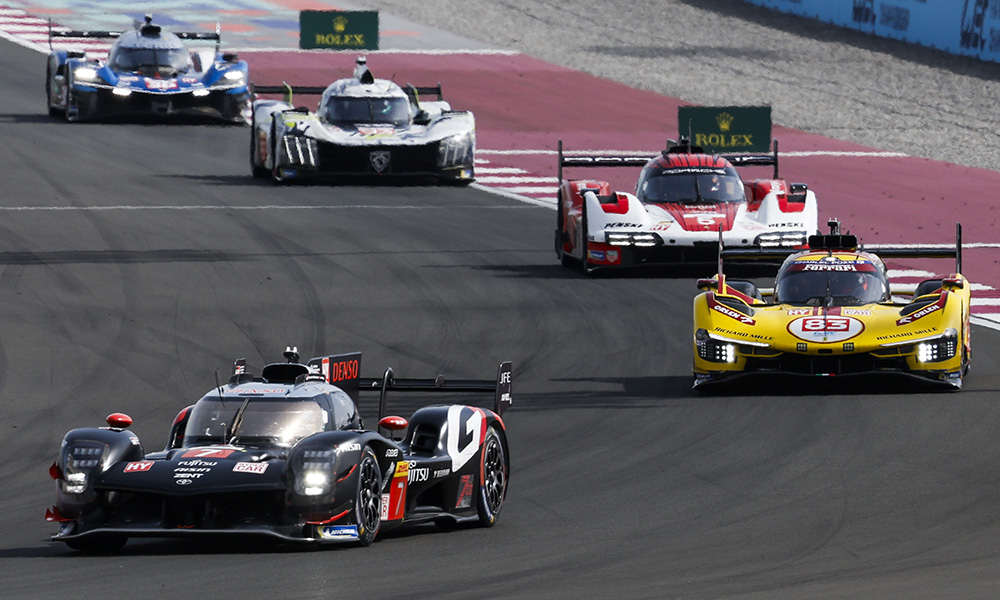
Photo: Julien Delfosse/DPPI
Toyota Gazoo Racing Europe technical director David Floury has expressed skepticism that a future unification between the LMH and LMDh rulesets would spell the end for Balance of Performance in the FIA World Endurance Championship’s top class.
Recent discussions between manufacturers and the FIA and ACO have centered on how the technical regulations could look beyond the current Hypercar homologation period, with the possibility of creating a new single formula to replace LMH and LMDh.
Porsche motorsport boss Thomas Laudenbach has been the leading proponent of such a move, recently reiterating that he believes it is “possible” for 2030.
Talk of unifying the two Hypercar platforms has also led to suggestions that the current system of BoP may no longer be necessary in such a scenario, as the various cars competing in the class would all become much more similar to one another.
But Floury doubts that it would be feasible to do away with BoP entirely in the top class, stating he believes that this would lead to manufacturers leaving the championship, as well as much larger gaps between the fastest and slowest cars.
“It depends what you target,” Floury said. “But I think the BoP was part of the ‘deal’ in Hypercar. Since the rules started in 2021 the idea of BoP was always part of the package, and many manufacturers committed based on this.
“I think if we removed the BoP, it depends how development is controlled, but BoP helps to keep the costs down. We might get back to a development war.
“And secondly, if you remove the BoP, it has to be accepted that this will bring significant gaps between the cars and some manufacturers will struggle to close the gap, looking at the gaps in the homologation parameters between the cars.
“For sure we should not expect that, if we get rid of the BoP, we will keep the same number of manufacturers in the next few years. It will drop pretty quickly because some of them will be stuck behind and they will go away.”
However, Floury said that idea of trying to unify LMDh and LMH should not be the main focus of discussions with the rule makers at present amid Toyota’s unhappiness with the current BoP process, which he notably criticized in Sao Paulo last month.
“Do we really think that having two platforms is the main issue right now?” he asked rhetorically. “At the end of the day, I don’t see that as the main issue.
“I think we can do better [with the BoP] than what we are doing now.”
Laudenbach: Development Restrictions Still Needed Without BoP
Going into more detail on a future unified Hypercar ruleset, Laudenbach suggested the idea of a system of concessions whereby only some manufacturers are allowed to develop their cars, in order to keep budgets under control even without BoP.
“I think [convergence] is going to make the whole thing a lot easier but don’t forget that we still have the point of budget control,” Laudenbach said. “I think the development needs to be restricted.
“I can probably think that we can nearly get rid of [BoP] because the cars, hopefully, will be quite close together. I could imagine that you allow development only if somebody’s a bit too [far] back. But I think we can minimize the impact and then I think it’s fine.
“I could imagine in some way to combine it with, ‘OK, if you’re running up front, you’re not allowed to do anything to your car, it’s frozen.’ If somebody’s more to the back [of the field], you allow them some kind of joker or some kind of steps.
“I’m not 100 percent familiar with MotoGP, but I think they have something in place like this. I’m not too much into the details but I can imagine something like that, which would probably be a lot more healthy.”
Whatever happens with the rules in future, Laudenbach stressed the importance of budget control to prevent a repeat of the arms race that led to the demise of the LMP1 hybrid era with the success exits of Audi and Porsche in 2016 and ’17.
“We also have to control the budgets because don’t forget how it came to what we see now [with BoP],” he said. “It came from LMP1 times when the budgets exploded.
“We’ve got to be sure that we’re not coming back to that. As an engineer, I’d love to [go back to LMP1]. But as somebody responsible for budgets, [it would be a] catastrophe.”
John Dagys contributed to this report



FIA GT World Cup
Watch Ferrari’s FIA GT World Cup-Winning Weekend in Macau

24H Series
Lineups Confirmed in Updated 24H Dubai Entry


Nürburgring Endurance
PROSport Aligns With Mercedes-AMG; New Team Structure

GT World Challenge Europe
Motopark Aiming to Become “Leading GT3 Team”


Michelin Pilot Challenge
KohR to Run Biffle Tribute Livery on Mustang GT4 at Daytona

GT World Challenge Europe
Verstappen Racing Switches to Mercedes-AMG


Michelin Pilot Challenge
Stewart Signs Multi-Year Deal With CSM; Set for GS Debut

Michelin Pilot Challenge
Random Vandals Confirms Two-Car BMW Effort

FIA GT World Cup
Watch Ferrari’s FIA GT World Cup-Winning Weekend in Macau

Porsche Carrera Cup NA
Watch Highlights of Carrera Cup NA’s Record Breaking Season

WeatherTech Championship
Watch Ford Racing’s Top Moments of 2025