Photo: Macau Grand Prix Organizing Committee
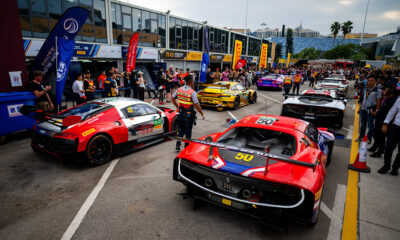
SRO Asia general manager Benjamin Franassovici has expressed confidence that grid numbers for the FIA GT World Cup will recover in the following years after the size of the field for this year’s Macau race slumped to 16 cars.
This year’s GT World Cup featured a reduction on seven cars compared to the 2024 event, a drop attributed to the introduction of torque sensors for the first time.
Mercedes-AMG was a notable absentee from the race for this reason, although the arrival of McLaren with a one-car effort from newcomer Optimum Motorsport ensured the number of manufacturers entered in the race remained stable at six.
Franassovici, whose organization helps the FIA to assemble the grid for the end-of-season street event, said he was satisfied by the quality of the assembled cars for this race and believes the drop in interest will prove temporary.
“Of course you always want more cars because people usually judge you on the numbers,” Franassovici told Sportscar365.
“We knew we would get fewer cars this year because of the technical change [torque sensors]. It has made it difficult for some of the usual teams to come, or else we would have had a full grid of 20 cars.
“Yes, 16 is not a big number, but we’re happy with the quality. We’re happy to have the McLaren as well after they didn’t quite make it last year, so it’s not so bad.
“Naturally, the numbers will go back up [in future].”
This year’s GT World Cup did not feature the smallest grid in the event’s decade-long history, as the 2018 race had only 15 cars, but marked only the third time that the event did not reach a 20-car grid after 2018 and ’19.
Franassovici hopes the falling costs of torque sensors, as well as the introduction of several new GT3 models in the next two years, will mean that the technology no longer presents such a stumbling block to prospective Macau entrants in future.
“When you introduce something new, it’s like anything in life, some people are reticent” he said. “It was a harder sell, for what is still a one-off race.
“Some didn’t want to invest; some cars are close to the end of their life cycle so the investment would have been significant. And we hope the price of the sensors will go down as they grow in numbers, because at the moment they are expensive.”
Although the introduction of torque sensors was decided by the FIA, Franassovici admitted the technology is likely to remain part of Macau into the future.
“It’s not our decision, but if they work, it would be difficult to go back,” he said.
Franassovici clarified that 23 cars remains the upper limit for the grid size even with the introduction of the FIA Formula 4 World Cup for this year’s Macau Grand Prix.
GT World Cup teams occupied temporary garages located in the paddock across from the main pit building, which was reserved for Formula Regional cars and motorcycles, with F4 cars, TCR machinery and other categories, including the SRO-run Greater Bay Area GT Cup, making use of the multi-storey parking garage that sits beneath the paddock.



Toyota GR Cup NA
Fletcher Edges Out Kohlbecker for Race 1 Pole at Arlington

WeatherTech Championship
Porsche 963 Given Weight Increase for Sebring

Toyota GR Cup NA
Kohlbecker Quickest in Practice at Arlington

Porsche Carrera Cup NA
Capestro-Dubets Joins GMG in Three-Car Carrera Cup Effort


European Le Mans Series
Sette Camara Completes Iron Lynx Mercedes-AMG Lineup


WeatherTech Championship
Vosse: Daytona Podium “Big Boost” for WRT’s IMSA Foray

Intercontinental GT Challenge
Verstappen Confirmed for N24 Debut; Will Contest NLS2


WeatherTech Championship
Listen to In-Car Audio from Valkyrie at Daytona

Porsche Carrera Cup NA
Drivers Give Early Impressions of New Porsche 911 Cup

Michelin Pilot Challenge
Introducing IMSA’s Latest 3D Scholarship Winner Nicky Hays

WeatherTech Championship
Watch the Rolex 24 Sights & Sounds