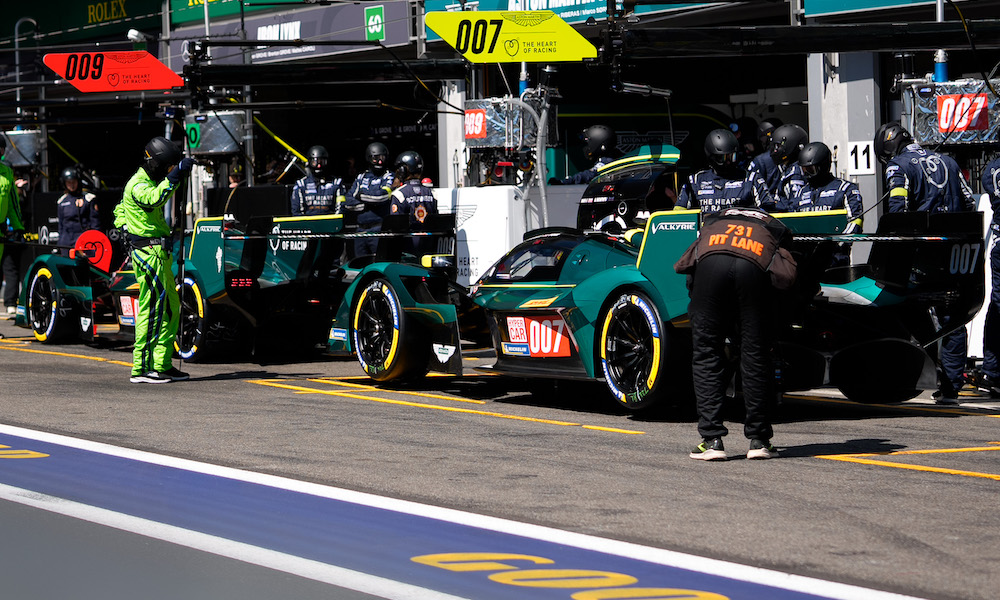
Photo: Nick Dungan/Aston Martin
Harry Tincknell said this year’s edition of the 24 Hours of Le Mans is ‘going to come too soon to think about trophies’ for Aston Martin as the brand’s Valkyrie Hypercar makes its debut in the French endurance classic.
The British racer will form part of a two-car effort with the V12-powered machine at Le Mans, sharing the No. 007 machine with compatriots Tom Gamble and Ross Gunn.
The lineup for the sister No. 009 machine, meanwhile, will consist of Marco Sorensen, Alex Riberas and Roman De Angelis.
The Valkyrie is heading to Le Mans off the back of some encouraging results in both the FIA World Endurance Championship and IMSA WeatherTech SportsCar Championship.
Most recently, Gunn and De Angelis finished eighth in the Chevrolet Detroit Sports Car Classic, while in WEC the car came close to its first points finish during the 6 Hours of Spa-Francorchamps.
However, Tincknell struck a realistic figure ahead of the Valkyrie’s first trip to the Circuit de La Sarthe, noting that Le Mans will also be a crucial part of the learning experience for the Heart of Racing Team and Aston Martin.
“We’re still only scratching the surface of the car,” Tincknell told Sportscar365.
“Unfortunately we are still experiencing little gremlins and things that trip us up, but next year we won’t because that’s the power of time.
“But I’m now seeing that we are able to hang with other cars and that we are getting closer.
“Some of the work we have done in the simulator has translated well into real life, and all these things are only just beginning to become operational.
“We were coming from a long way back but we are closing the gap quickly. For me, as long as we are making progress every weekend, it’s good.”
As part of the preparations for the Valkyrie’s first Le Mans outing, Heart of Racing recently completed a two-day test at Monza, which Tincknell described as “the closest place to Le Mans to test the car” in terms of characteristics.
The 33-year-old made no effort to downplay the scale of the challenge that Aston Martin faces as it tackles Le Mans for the first time with its new car, but was also hopeful the British marque will be able to show itself well.
“It won’t be easy,” Tincknell said.
“From everything I’ve seen from the last few races, including IMSA, the car has been reliable. The way the car performed in Sebring gives us confidence for Le Mans.
“If we were somewhere in the mid-pack in the race, that would be fantastic, and if we can finish the race with no issues, that’s goal number one.
“And it’s amazing how far up the field you can get if you achieve that goal.
“It’s going to come too soon to think about trophies this year. But certainly we know that every kilometre we do this year will only help for next year.”
Carter: “No Reason” Why Le Mans Lead Lap Finish “Shouldn’t Be Our Target”
Adam Carter, Aston Martin’s head of endurance, laid out his own goals and expectations for the Valkyrie’s first race at Le Mans, expressing confidence that the car would be capable of finishing on the lead lap at the end of the 24-hour contest.
Last year, nine cars finished the race on the lead lap, which set a new record at Le Mans.
When asked whether a lead lap finish is achievable for the Valkyrie at Le Mans this year, Carter replied: “The regulations are formatted to allow that.
“They created that situation last year so there’s no reason why we shouldn’t have the [chance].
“You always need a level of pace within the car in respect of the safety cars in order for it to come through.
“So the way the regulations are set, the way it manifested last year, that allowed for a number of cars to run on the lead lap. So I see no reason why that shouldn’t be our target because we want to be competitive.
“But we also, as always, respect the level of competition and we also respect the fact we’re coming in [for] our first year, whereas people will be going with the same cars into their third year.
“Everything’s new and a learning curve for us here. Other people are coming and reflecting back on their changes from last year.
“They’re looking at delta performance, we’re looking at absolute new performance and learning a lot more. So that would be an ambition, but we also have to just respect the level of competition.”
Jamie Klein contributed to this report




GT World Challenge America
Barber Thursday Notebook

Pirelli GT4 America
DeLong Quickest in Opening Practice at Barber

GT World Challenge America
Sargent ‘Has to Win’ Barber to Set Up for Double Points Finale

GT World Challenge America
Romanelli: TR3’s Road America Pro-Am Win a “Sigh of Relief”

24H Series
24H Dubai to be Moved to Kyalami

Intercontinental GT Challenge
29 Cars on Provisional Indy 8H Entry List


Asian Le Mans Series
Asian Hypercar Class in Jeopardy for 2026-27 Season


WeatherTech Championship
Watch the Full-Length Replay of Battle on the Bricks

Porsche Carrera Cup NA
Watch Full-Length Replays of Rounds 11 & 12 at Indy

Lamborghini Super Trofeo NA
Watch Full-Length Replays of Rounds 9 & 10 at Indy

WeatherTech Championship
No Letting Up at Indy as Team WRT Takes First IMSA GTP Win

Michelin Pilot Challenge
Watch the Full-Length Replay of Indianapolis 120