Photo: IMSA
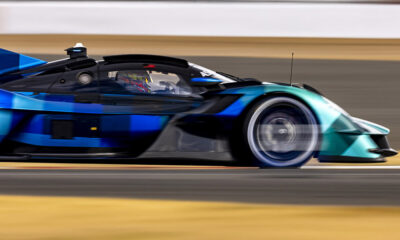
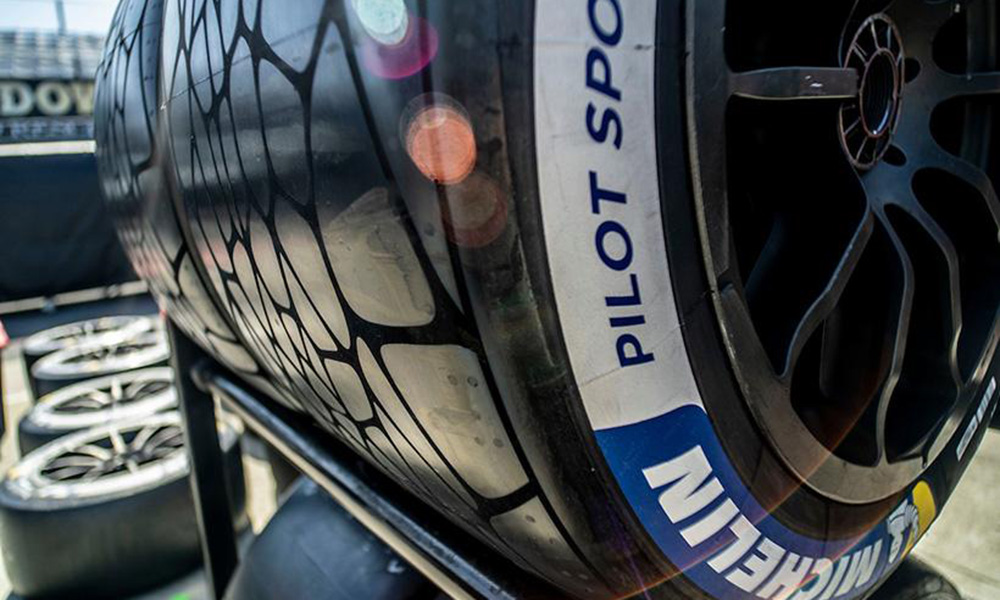
At first glance, Michelin’s new Pilot Sport Endurance prototype tire reveals a the proverbial ‘wow’ factor. Its tread looks highly unusual, with a glistening color and pattern that differs from any other prototype tire in motorsport.
But its purpose is more than just stunning looks: it’s also about delivering equally stunning performance while achieving enhanced sustainability targets.
Michelin, the Official Tire of IMSA, brings not one but two new tires to WeatherTech SportsCar Championship competition in 2026.
The new Pilot Sport Endurance tire for GTP is the headliner, while the GT classes will shift to more of an evolutionary tire: the Pilot Sport Pro GT H1+.
The prototype tire emerges as the result of a final yearlong run of testing across four circuits: two globally at Lusail International Circuit in Qatar and Paul Ricard in France, and two domestically at Sebring International Raceway and Watkins Glen International.
The purpose is to maintain the existing tire line peak performance and balance, while delivering improved warm-up, better consistency and wear while also maintaining the durability over the double stints it’s required to run as part of both Michelin and IMSA’s respective sustainability targets.
This range of circuits covered low-to-medium severity tracks, and moderate-to-significant temperatures ranging anywhere from 70 degrees ambient and track to near 100 degrees ambient and well over 100 degrees on track at Watkins Glen.
As the tire is developed for both IMSA GTP cars and FIA World Endurance Championship Hypercars – cars in both LMDh and LMH specification – it runs a wide gamut of vehicles.
All the while, the enhanced sustainability goal was a major factor in the development.
“The goal was to produce a racing tire with 50 percent recycled and renewable material in the tire, which is a first,” explained Hans Emmel, Michelin’s corporate racing manager for the WeatherTech Championship.
“That was one of the stated targets. And in doing so, we didn’t want to lose performance.
“We need to keep the same peak performance that we have, but at the same time acknowledge we needed to improve warm-up, so the drivers have a better feel for the tire on their out laps.”
It’s a fair and honest assessment from the manufacturer, as the warm-up period often took multiple laps in the opening stages of a stint.
Driver feedback proved a big part in the change to the new Pilot Sport Endurance tire, which appears to have resolved that.
“We’re hearing about improved consistency and slightly better wear,” Emmel said.
“After the morning test session (at Daytona), I’ve got a lot of feedback from drivers in different teams that the warm-up is definitely better and the consistency is directionally better.”
The IMSA-sanctioned November test at Daytona marked the first full-scale test for this year where the new Pilot Sport Endurance tire was available to all competitors.
Those that stuck around at either or both of Sebring or Watkins Glen may have sampled the tire in those respective sessions.
Ricky Taylor, co-driver of the No. 10 Wayne Taylor Racing Cadillac V-Series.R, was particularly pleased with the change.
“They did an amazing job with the new tire,” said the elder Taylor brother. “We only ran on the medium today, and even, like, no matter where we were in the temperature window, the warm-up was really good.
‘”Deg seemed no worse. But the warm-up was significantly better. I think every driver hears that and is breathing a big sigh of relief.”
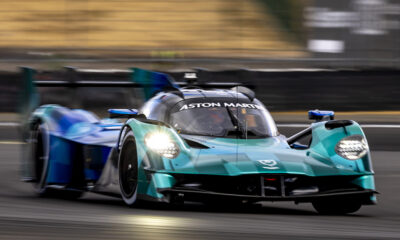
Ross Gunn, co-driver of the No. 23 Heart of Racing Team Aston Martin Valkyrie, had an opportunity to compare and contrast from Watkins Glen.
“This tire is definitely noticeably easier to get up to temperature, and we felt that immediately in Watkins Glen,” said the Englishman. “It was the hottest day of the year there, but still it was good learning.”
Double stinting tires has become a hot topic in the prototype paddock the last several years, and Michelin took note of it when building, testing and designing the new tire.
The sustainability targets come with a need for double stinting at the five Michelin Endurance Cup rounds.
The warm-up challenge tended to have a knock-on effect early, where teams rarely desired to take new tires to account for the warm-up period but adapted over time.
“Coming in in 2023, these were brand-new cars and brand-new tires,” Emmel reflected. “And I think it took some time for the teams to learn their cars, to learn how they interact with the tires, for everybody to learn about how the tires function and what temperature windows they function the best, and how to put them in that window.
“The teams have learned a tremendous amount about how to get heat into the tires when they need to and how not to put that into the tires when they don’t want to, depending on the conditions.
“That naturally leads to using the tires over a longer duration, so it’s more effective and easier for the teams to implement.”
That’s particularly pertinent at Daytona, where ambient and track temperatures can be as cold as the low-to-mid 30-degree Fahrenheit range but can also rise to north of 70 degrees ambient and 80s on track.
Michelin GTD Pro/GTD Tire Highlights Evolution
The new GT tire isn’t a wholesale change, instead more of an evolution. Per Jeff Fischer, Michelin motorsports series manager for the WeatherTech Championship, the changes come after identifying two key areas of enhancement.
“There’s two changes to it,” he said. “One is improved bead fit on rims of all the different GT OEMs, and the second is a change to the tread profile to improve thermal robustness at hotter condition tracks.
“There’s no change to the compound or any other casing or construction changes.
“We just identified a few small areas that we can continue to make improvements and accommodate the need of the competitors in the category and composition for the tire to be robust for this series.”
The 2026 season will be the eighth season together where Michelin supplies all cars amidst the WeatherTech Championship. Additionally in IMSA, Michelin also supplies two Challenge series, Whelen Mazda MX-5 Cup presented by Michelin and Ford’s Mustang Challenge North America.
On a given weekend, that means Michelin may supply more than 100 cars, compared to its previous time building bespoke tires with different compounds in the open-competition era of GT Le Mans for five manufacturers and nine to 10 cars.
“You look at how many different manufacturers won and how many different teams won, and the thing they all had in common is they are all running at the same tire,” Fischer said.
“So to be able to offer a product that’s so competitive, all the manufacturers and teams that choose to be here are all part of making such a good battle.”
Emmel added: “I think it rolls back into more of a track-to-street message, and certainly the fact that Michelin wants to use motorsports as a laboratory.
“Michelin, as a company, has a very publicly stated goal of having 40 percent of materials going into its roadgoing tires, be recycled or renewable materials by 2030.
“We just introduced the Michelin Pilot Sport Endurance tire with 50 percent.
“We’re already doing it in motorsports, so that’s that perfect example of motorsports is the laboratory to figure out and innovate how we can move forward on the street with all of our products available.”



Lamborghini Super Trofeo NA
Taurino Takes Win on Sunday Amid De La Torre Retirement

Porsche Carrera Cup NA
Jeansonne Wins Race 2 at The Brickyard in Points Haul

WeatherTech Championship
Sorensen Set for Full Time Campaign in Car Blanche Aston

GT World Challenge Europe
Green, Vermeulen Triumph in Race 2 in Emil Frey Ferrari

WeatherTech Championship
Mies: Driver Chemistry Key to Ford’s GTD Pro Title Fight

Lamborghini Super Trofeo NA
Formal, Doyle to ‘Have Fun Final Races’ After Clinching Title Early

WeatherTech Championship
Diuguid Explains Decision to Draft In Heinrich for Indy

Intercontinental GT Challenge
MPC Open to Ford Mustang GT3 EVO Future Beyond Suzuka

European Le Mans Series
Hanley Fastest in Twice Red-Flagged Silverstone FP1

Nürburgring Endurance
Plans for New Nürburgring Series Delayed to 2028


Intercontinental GT Challenge
AO by Absolute Porsche Takes Dominant Suzuka Win

WeatherTech Championship
Watch IMSA’s ‘Win the Weekend’ Ford Mustang GT3 Shop Tour


WeatherTech Championship
IMSA Endurance Hour Podcast: Ep. 38: Ellis, Ward & More

Ferrari Challenge NA
Watch Full-Length Replays of Rounds 11 & 12 at Road America

Intercontinental GT Challenge
Watch Suzuka 1000km Highlights