Photo: Germain Hazard/DPPI
Bruno Famin, Alpine’s vice president of motorsport, has urged rule-makers to ‘send a proper signal’ regarding the future of hydrogen cars in the FIA World Endurance Championship, explaining that the series has a “chicken and egg” problem due to a lack of technical regulations.
The French manufacturer is one of the brands that has taken an active interest regarding the application of hydrogen in both road cars at large as well as in motorsport.
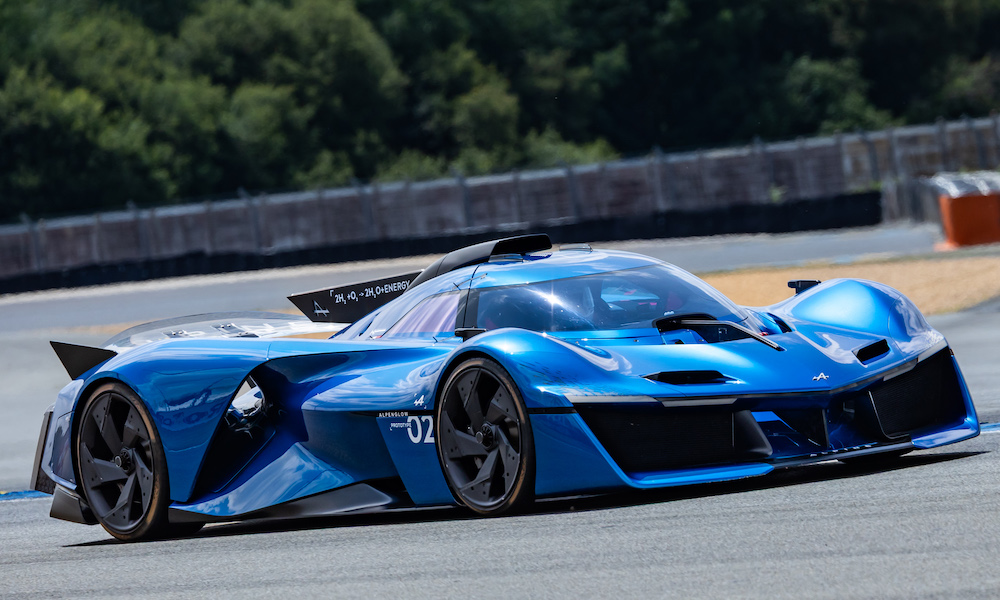
Late last year, it unveiled the Alpenglow Hy6, the latest version of its hydrogen-powered concept car, featuring a 3.4-liter, twin-turbocharged V6 engine.
The car has since carried out demonstration runs at both the 24 Hours of Le Mans as well as the Goodwood Festival of Speed so far this year.
When it was revealed in October 2024, Famin described the Alpenglow Hy6 as “the perfect example of what is possible to achieve the essential step of reducing carbon emissions in motorsport.”
However, when it comes to the current situation regarding the implementation of hydrogen in ACO-rules racing, Famin described the situation as “a bit chicken and egg,” pointing to a lack of technical regulations for the introduction of hydrogen cars to Le Mans and the WEC.
Bringing hydrogen cars to the French endurance classic has long been a target for the Automobile Club de l’Ouest and its president Pierre Fillon, who recently reiterated that a debut in 2028 remains the goal.
Fillon stated at the time that ‘it is up to the manufacturers to come,’ with Toyota also having given a renewed indication of interest by unveiling the GR LH2 Racing Concept in June.
However, Famin has urged rule-makers to move forward with technical regulations, as the lack of such information prevents brands like Alpine to be able to sign off on a hydrogen racing project at a board level.
“To me, it’s a bit chicken and egg,” said Famin.
“There is no regulation and as there is no regulation we can’t even build the project to go to the top management saying, ‘We can do this, this is what it what it will cost.’
“On the other side, there is no manufacturer decision. Somebody has to move on. I think it’s the promoter that has to move first because it’s always like that.
“We need the promoter to send the proper signal for us to have the right information, to be able to have a project, have a proper study and have a go or no go from our board.
“Of course, Alpenglow is amazing and we are super proud to have this car which is really a flagship for all of Alpine. The design is incredible, the technology is incredible.
“Of course we will be very happy to have that on the track for racing one day, but it depends on a lot of things for the time being.”
An initial target set by rule-makers to have technical regulations ready to share with interested manufacturers by the end of last year was missed.
Most recently, the FIA confirmed that it had approved a framework of regulations governing hydrogen safety during the most recent World Motor Sport Council meeting in Macau, which was held in June.
The FIA has stated that this framework was developed with input from industry experts across various sectors, together with automotive manufacturers as well as the ACO, setting “strict standards for vehicle integration, storage systems, and refueling procedures.”
At the same time, Famin offered a cautious assessment of the current situation surrounding hydrogen from a wider perspective outside of motorsport, saying the planets have “become a bit disaligned” in recent months.
A report from Reuters in July cited Arturo Gonzalo, CEO of Spanish gas grid operator Enagas, who declared that Europe’s hydrogen infrastructure currently faces a delay of two to three years.
Meanwhile, a number of significant companies, including the likes of steel producer ArcelorMittal and energy giants Repsol, BP and Shell have all scaled back investments or scrapped projects revolving around green hydrogen due to a combination of elevated production costs and weak demand.
“It looks like, in the last year, there was a kind of hydrogen bubble everywhere in Europe with a big investment announced in producing green hydrogen, building a distribution network,” said Famin.
“And it looks like with the economic situation, things are not going as fast as expected, and the bubble has reduced quite a lot.
“Quite a lot of stakeholders in hydrogen, or the mobility, or energy system, are reconsidering some things.
“Even for heavy industry, de-carbonise heavy industry, which are the main programs in Europe, they are delayed. We need to see how things evolve globally.
“I am still convinced hydrogen, both for ICE and fuel cell, makes sense in terms of decarbonizing mobility, but we need to align all the planets.
“Last year we thought we were not far, but the planets have become a bit disaligned since and we need to have the next window. It will take more time than expected I think.”



Pirelli GT4 America
ACI Expands to Four-Car GT4 Effort; Yardley in for Full Season

GT World Challenge America
Coleman, Telitz to Continue in Archangel McLaren

WeatherTech Championship
IMSA’s ‘Win the Weekend’ to Return for Fourth Season

GT World Challenge Europe
Razoon to Make Full Season Debut in Porsche Entry

GT World Challenge Europe
Leung First Confirmed Driver for Paradine BMW Entries


Intercontinental GT Challenge
Bathurst 12H Red-Flagged After Massive Crash

Intercontinental GT Challenge
Mies Escapes Injury After Kangaroo Strike Ends Ford’s Race

Intercontinental GT Challenge
Gounon Accuses Van Der Linde of “Bulls*** Driving” After Hit

Intercontinental GT Challenge
GruppeM Mercedes-AMG Wins Wild, Red-Flagged Bathurst 12H

WeatherTech Championship
IMSA, Laguna Seca Planning ‘Throwback’ Weekend

24H Le Mans
WTR Among 18 Hypercars on 24H Le Mans Entry List

Intercontinental GT Challenge
Watch the Full-Length Replay of Bathurst 12H

Intercontinental GT Challenge
Watch Bathurst 12H Highlights

Intercontinental GT Challenge
Watch Bathurst Qualifying, Pole Battle Highlights