Photo: Toyota
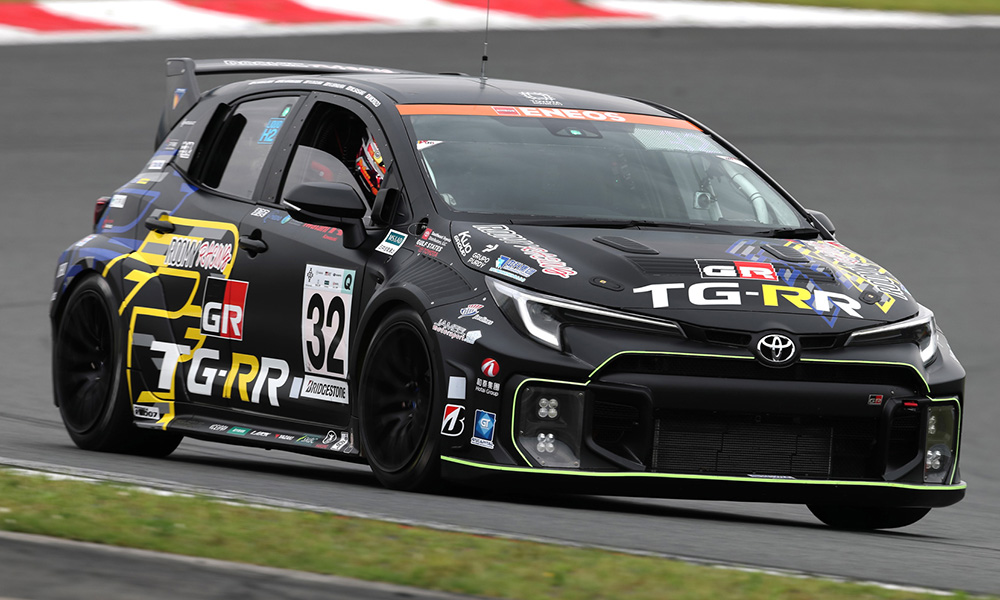
Toyota’s liquid hydrogen-powered GR Corolla H2 Concept enjoyed its strongest run in the Fuji 24 Hours yet last weekend, following a raft of improvements made to the car for its fifth outing in the Super Taikyu blue riband.
The No. 32 car fielded under the unified ‘Toyota Gazoo Rookie Racing’ (TG-RR) banner completed a total of 468 laps across a race that lasted for 23 hours after fog caused the start to be delayed by an hour, and which was also neutralized by two red-flag periods totalling almost three-and-a-half hours due to poor visibility.
That meant it fell just short of its previous record of 478 laps, set in 2022 when the car was still running on gaseous hydrogen, before the switch to liquid hydrogen in 2023.
However, in terms of the percentage of the winning car’s laps completed, this was by far the Corolla H2’s most impressive showing, as it completed 83.6 percent of the winning car’s laps, as opposed to 62.9 percent in 2022.
Sharing driving duties aboard the No. 32 car were Toyota chairman Akio Toyoda, racing as ‘Morizo’, Yasuhiro Ogura, Masahiro Sasaki, SUPER GT regular Hiroaki Ishiura, Mako Hirakawa (younger sister of FIA World Endurance Championship racer Ryo) and Kazuki Nakajima, the vice-chairman of Toyota Gazoo Racing Europe.
Improvements to the Corolla H2’s efficiency and refueling time, as well as weight saving, were the main objective of the changes made to the car since last year’s Fuji 24 Hours, when the car was plagued by electrical issues and could only complete 332 laps.
While Toyota’s focus up to now had been on matching the power output of gasoline-powered cars with its hydrogen power unit, this time it introduced a ‘lean combustion’ mode designed to respond to the driver’s accelerator movements, detecting when high power output is not required, to increase efficiency.
Additionally, a new internal piston structure for the car’s filling valve was adopted — eliminating the need for an external actuator, saving weight and reducing the risk of leakage, while also improving filling speed by 30 percent.
TG-RR also fielded another entry in the ST-Q class for cars featuring experimental technologies, the No. 28 GR86 Future FR Concept, which was powered by low-carbon gasoline featuring 20 percent bioethanol developed by Eneos.
This car, shared by SUPER GT racers Kazuya Oshima, Nirei Fukuzumi, Sho Tsuboi and his wife, fellowing racing driver Aimi Saito, Daisuke Toyoda (son of Akio) and Eisuke Sasaki, won the ST-Q class, completing a total of 523 laps, finishing 13th overall.
Overall victory went to the TKRI Mercedes-AMG GT3 Evo driven by gentleman racer ‘Daisuke’, Tatsuya Kataoka, Shunji Okumoto, Yuhki Nakayama and Yuya Motojima.
That was after the Seven x Seven Racing Porsche 911 GT3 R, which finished second in the hands of ‘Bankcy’, Kiyoto Fujinami, Taichi Watarai and Joao Paulo de Oliveira, picked up a 60-second stop-and-hold penalty for passing under full-course yellow.
Craft-Bamboo Racing looked to have a good chance of becoming the first international team to win the race, having led for much of the distance, before contact left the No. 33 Mercedes-AMG with exhaust damage that ultimately precipitated the car’s retirement while factory Honda racer Kakunoshin Ohta was at the wheel with four hours to go.
Nissan’s beleaguered Z NISMO GT4 program took victory in the ST-Z class for GT4 cars courtesy of the No. 25 Team ZeroOne car whose lineup included the now-retired Ronnie Quintarelli, as well as current SUPER GT racers Tsugio Matsuda and Teppei Natori.



Nürburgring Endurance
Driver Killed in N24 Qualifiers Race 1 Accident

FIA WEC
Imola Saturday Notebook

Nürburgring Endurance
N24 Qualifiers Red-Flagged for Serious Seven-Car Accident

Porsche Carrera Cup NA
Sargent Scores Dominant Saturday Win at Long Beach


WeatherTech Championship
Long Beach Pre-Race Notebook

WeatherTech Championship
Penske Porsches Face 99-Pound Weight Increase for Long Beach

GT World Challenge Europe
Stroll Targeting Further GT3 Outings in 2026


GT World Challenge Europe
Aston Scores Unexpected Win in Dramatic Paul Ricard Opener


FIA WEC
Watch WEC’s Imola Race Preview

WeatherTech Championship
Watch the Full-Length Replay of Long Beach Qualifying