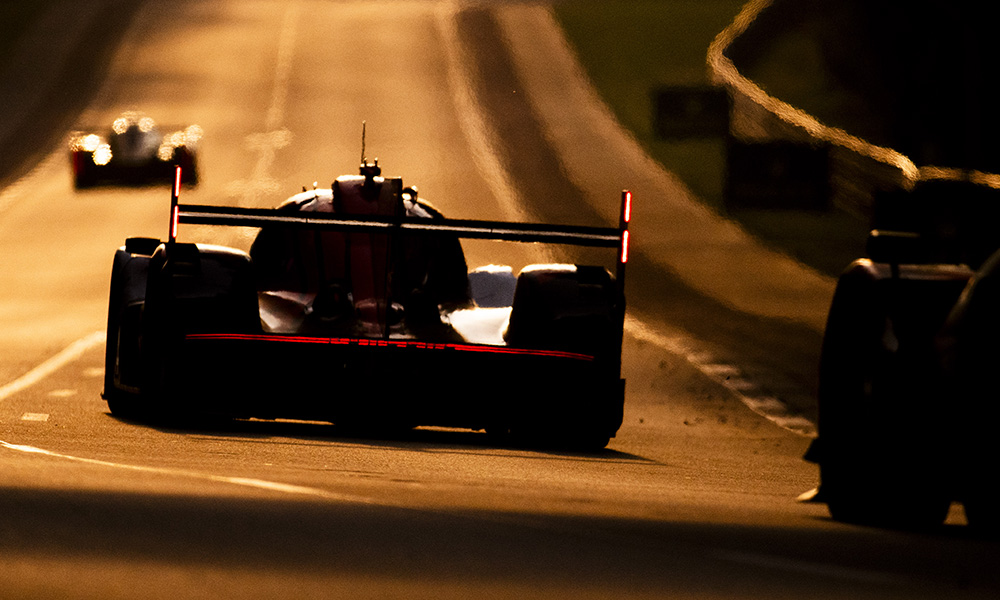
Photo: Charly López/DPPI
Porsche Motorsport boss Thomas Laudenbach said he believes that a single top-class prototype platform is “possible” for the FIA World Endurance Championship and IMSA WeatherTech SportsCar Championship by 2030 amid intensified talks on a common ruleset.
Laudenbach, who had initially floated the idea of a unified platform that would replace the current LMDh and LMH formulas, indicated the concept continues to be a key discussion point in manufacturer working group meetings.
Speaking to reporters during last weekend’s Lone Star Le Mans event at Circuit of The Americas, where the latest round of OEM talks occurred, Laudenbach pointed out that the FIA, ACO and IMSA have yet to confirm the exact ruleset for the top class despite the WEC recently announcing an extension of the Hypercar category to 2032.
“To be precise, we had the homologation period of five years up to 2027. This one has been extended until 2029,” said Laudenbach.
“Then there has been an announcement that the Hypercar class will be extended until 2032, saying nothing about homologation and nothing about the rules.”
Laudenbach’s comments echo that of IMSA President John Doonan, who indicated to Sportscar365 in June that there could be an “evolutionary” step in the Hypercar/GTP technical class regulations entering the next decade.
When asked by Sportscar365 if he believes a change in the regulations could come before 2030, Laudenbach said: “It would be great if it would be earlier. I just don’t know if it’s possible.”
He added: “I think, in the end, the sanctioning body can do any change as long as the manufacturers agree.
“But the fact right now is that we have a homologation period of the actual cars until 2029.
“If you ask me if I would support the idea of merging these two, let’s say, difficult set of technical rules, yes of course. I said this one-and-a-half years ago.
“Most people were laughing at me. I think this has changed a lot. I was proposing that because I had a certain expectation that I think we see now.
“Just commenting from all my talks to colleagues of other manufacturers and also to the sanctioning body, I think there’s some kind of agreement that this would be a good step.
“I’m not saying how to do this. I’m not saying exactly when; obviously there are some constraints. But generally talking, yes, I think it would be a good step.”
While the FIA and ACO have yet to officially comment on the matter, it’s understood that a change in technical regulations is unlikely before 2030, amid newcomers Genesis, Ford and McLaren all set to debut LMDh-spec machinery in the next two years.
Additionally, Peugeot is pursuing plans to roll out with an all-new car in the WEC for the 2027 season.
Laudenbach, however, stressed that he believes talks should not center on the elimination of LMH and adoption of the current LMDh ruleset but instead a modified version of LMDh that could potentially allow manufacturers to build their own chassis and hybrid systems.
Currently, OEMs must choose from one of four chassis constructors and all run the same rear wheel-mounted spec hybrid powertrain.
When asked if the topic of four-wheel drive, which LMH regulations permit and is utilized by Toyota, Ferrari and Peugeot, is a stumbling block, Laudenbach said it’s more about the smaller details.
“I’m pretty sure that it is possible from the set of rules to give everybody the same base,” he said. “That’s what we’re talking about.
“It’s not about that it needs to be exactly LMDh today. The principle is that it needs to be the same possibility for everybody.
“We are talking about a FIA world championship with a lot of manufacturers on a top level.
“The most important thing is that because little differences make differences. Give everybody the same possibility to do it.”
In addition to chassis and hybrid systems, Laudenbach pointed out the importance of allowing the same level of freedom in terms of software tuning, which is currently significantly more restricted in LMDh than in LMH.
“The LMDh cars have a common hybrid system, which we cannot really touch, we can just use it,” he said. “I cannot do any software in it (just calibration).
“If I’ve got a [LMH], I can do software on the control system. It’s a big difference. If it’s my own system I can go down [into the software].
“It should be the same for everybody.”




Porsche Carrera Cup NA
Stiak Earns Win; Maxson Clinches Title in Race 1 at COTA

Lamborghini Super Trofeo
Barcelona to Host Lamborghini World Finals for First Time

Lamborghini Super Trofeo
De La Torre: Low Grid Spot Chance to “Show My Racecraft”

Lamborghini Super Trofeo
Lind, De La Torre Lead Throughout Pro/Pro-Am Opener

Porsche Carrera Cup NA
Maxson Shatters COTA Record to Claim Race 1 Pole

WeatherTech Championship
Joint IMSA-SRO Daytona BoP Test Canceled

FIA GT World Cup
New AO Design Part of Four-Car Porsche Macau Assault

GT World Challenge Europe
Engel, Auer Take Overall Drivers’ Title After DSQ Appeal

FIA GT World Cup
Aston Martin Returns in 18-Car Entry, Fuoco Won’t Defend Win

WeatherTech Championship
Vesti Steps Up to Full Season Drive With Action Express


WeatherTech Championship
IMSA Endurance Hour Podcast: Ep. 41: Hall of Fame Drivers


WeatherTech Championship
Watch NBC’s WeatherTech Championship Season Review

WeatherTech Championship
IMSA Endurance Hour Podcast: Ep. 40: Foley, Auberlen & More