Photo: Julien Delfosse/DPPI
ACO President Pierre Fillon has insisted that the organization’s deal with Toyota to provide hydrogen powertrains does not spell the end for the potential for fuel cell technology in the FIA World Endurance Championship and 24 Hours of Le Mans.
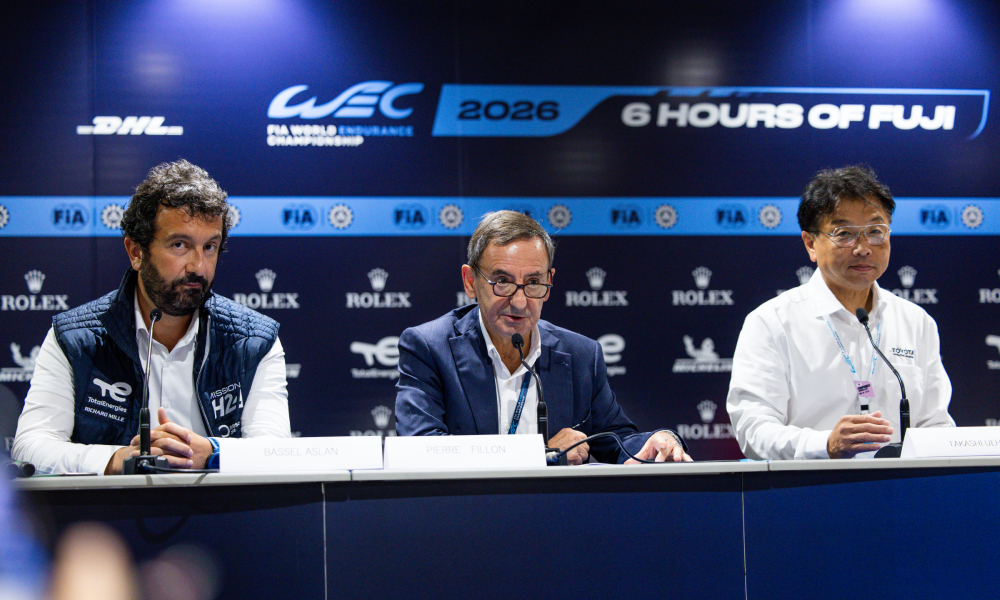
Fillon made the remarks last month speaking to reporters after a press conference held on the eve of the WEC’s 6 Hours of Fuji round, where it was revealed that the ACO-backed H24EVO project would switch to internal combustion-based hydrogen propulsion developed by Toyota after initially being fuel cell-powered.
Toyota has long been the current WEC manufacturer with the biggest interest in hydrogen, having pioneered its H2 combustion technology in Japan’s Super Taikyu series, although other marques, such as BMW, have expressed interest in fuel cells.
H2 cars are set to be allowed to race as early as 2030 as part of a new generation of Hypercar machinery in the WEC and at Le Mans include provisions for both fuel cells and combustion-based cars powered by liquid hydrogen.
“Fuel cell is still in the scope,” said Fillon. “But for the moment, it’s easier to come with an ICE, in terms of technology and in terms of weight.
“With fuel cell, we need some more development, because it’s still early for the moment. But in the rules, it will be possible to come with a fuel cell.
“Another important point for the fans, we are in motorsport, and I think the noise and the sound is something important, and with the ICE, you keep this feeling.”
As revealed by the ACO earlier this year, a system of Equivalence of Technology is set to be used to balance hydrogen and conventional Hypercars under the 2030 regulations, amid a planned 160 kg minimum weight difference between the platforms.
However, Fillon would not be drawn on whether H2 machinery could be made fast enough to compete at current Hypercar speeds, or whether conventionally-powered cars would be need to be slowed down as part of the balancing process.
“We have no data about H2, so we need to work step-by-step,” said Fillon. “As soon as we have enough data to be able to have a good balance between gasoline Hypercar and H2 Hypercar, we will be able to balance the two [types of] cars.
“Of course, the target in the short-term is to have the same level between H2 [and gasoline], but at the start, we don’t want that H2 is two or three seconds faster at Le Mans, because we have no data.
“We are in 2026 [now], in 2029 we will have more data, and we will be able to unify them.”
A target date to reveal the revamped H24EVO to the public has been set for 2028, after which the car could potentially race at Le Mans as a Garage 56 entry, stated Fillon.
“It’s part of the possibilities,” he said. “We have to build the car. We have the engine, we have the tank, we have 18 partners for Michelin H24, so the key now is to build the car.
“As soon as we see the car on the track, we will see if we start with Garage 56 or Michelin Le Mans Cup, or in ELMS, and then, why not more?”
Earlier this year, it was announced by the ACO that hydrogen storage tanks will be part of wider plans to redevelop the Le Mans pit complex by 2030 or ’31, but Fillon suggested a temporary solution could be implemented before that.
“At the beginning we will have one, two or maybe three [H2] cars, and we are working on a mobile system,” he explained.
“Of course we will have some pipes in the paddock, because the regulations are not the same in Japan as in France. In Japan, you can have your H2 truck just behind the garage, but in France it’s impossible; you have to have 100 meters between them.
“So the big infrastructure will be the pipe between the truck and the garage itself, but the rest of the system will be mobile, to be able to use it this system in Spa and in Fuji. But we are working on it with the reconstruction of the pit building.”
Fillon clarified that the hydrogen fueling system will likely be located towards the end of the pit lane, where the final pit garages are located currently.




FIA GT World Cup
Bamber Makes Surprise Macau Return With Audi


McLaren Trophy America
Watch Full-Length Replays of Final Rounds at Indy


Intercontinental GT Challenge
13 Autosport Set for Bathurst 12H Debut; N24 Plans in Works


WeatherTech Championship
IMSA Honors Season’s Best at Night of Champions


WeatherTech Championship
Road Atlanta Post-Race Notebook
McLaren Trophy America
Watch Full-Length Replays of Final Rounds at Indy

Toyota GR Cup NA
Watch Full-Length Replays of Rounds 13 & 14 at Indy


Pirelli GT4 America
Watch the Full-Length Replays of Rounds 12 & 13 at Indy

Intercontinental GT Challenge
Watch Highlights of Indy 8H