Photo: United Autosports
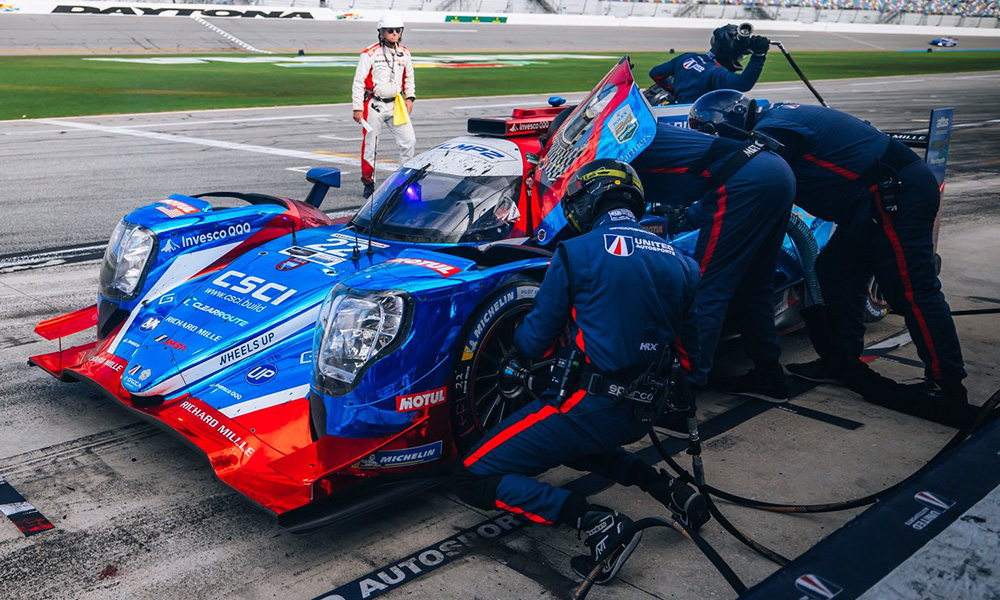
United Autosports’ decision to split up its two cars on pit lane proved to be a pivotal factor in the team’s success in the IMSA WeatherTech SportsCar Championship according to its CEO Richard Dean.
The Anglo-American squad, which made its full season WeatherTech Championship debut in 2024, has been the only two-car operation in the LMP2 ranks and suffered a challenging first campaign, finishing fifth and seventh in the standings with a single class win at Road America to its credit.
While much of the season could have been down to growing pains, amid the launch of its new U.S. outpost run by Jr III Racing’s Billy Glavin, Dean largely attributed it to the pit stop sequence and IMSA’s smaller boxes that led to several miscues and lost opportunities.
“We’re the only P2 team that has two cars,” Dean told Sportscar365. “We went through a difficult season when you’ve got both cars in the pits together. That created some problems at opportune moments during safety cars where your cars were in the wrong order.
“LMP2 is such a ferocious fight that you can’t afford to have a pushback or go-along or whatever.”
The decision was made to split up the Nos. 2 and 22 entries on pit lane, the same strategy that Team Penske took with its factory Acura DPi operation, in order to prevent the team cars from overlapping each other and potentially causing delays in pit lane.
“We then had to split the pits,” said Dean. “That was no mean feat into making that work. You want all the benefits of a two-car team but when the race starts, you want to run them individually but still have that communication.
“Otherwise, you’re wasting the benefits of a two-car team.
“It was a huge financial investment to do that split last year. But even then, everything from all the IT operations, the connectivity between the two pit walls in communication… IMSA does [the pit box locations] in championship order.”
Dean said he didn’t originally imagine having a two-car team, in a traditional pit setup, would be a disadvantage in the tight confines of WeatherTech Championship pit lanes.
“Initially I didn’t think so until we started getting into racing and we were in the wrong order,” he said. “When a safety car comes out and pits for prototypes were opened, you realize you cost yourself three or four seconds.
“But when everybody is in a queue, you can go from the front of the grid to the back of the grid.
“You can’t predict for something that happens on track that gets your cars in the wrong order.
“I think we enjoy running a two-car team from what we get in testing. We can’t take away the impact from the continuity, not just the staff but the drivers as well.”
In 2025, in United’s first “split” pit lane setup, the No. 22 entry of Dan Goldburg and Paul di Resta, who teamed with James Allen and Rasmus Lindh won the Rolex 24 at Daytona, led the LMP2 standings up until the third-to-last round of the season at Road America when Goldburg had contact with the No. 04 CrowdStrike by APR Oreca 07 Gibson of George Kurtz that took him out of contention.
Goldburg ended up finishing third in the standings.
“The 22 car won at Daytona and won again at Watkins Glen, we led that championship right through to Road America where Dan got taken off in Turn 1 and into the wall and we couldn’t recover,” said Dean.
“Dan Goldburg put an awful lot of trust and faith in us when we turned up as a European team into IMSA and he’s gone through the good and bad with us.
“He’s helped push us into the right direction. The same with Paul di Resta, who has been a constant in our P2 team for [many years]. We have a great relationship and he’s constantly thinking of ways.
“He doesn’t just come in, do his job and go. He knows all the guys and all the teams. That relationship with Dan and Paul is great.
“The contribution they all make to making sure we’re competitive on track and efficient off-track.”
While failing to make the podium in January’s season-opening Rolex 24, United claimed its first-ever 1-2 finish in WeatherTech Championship competition in last month’s Mobil 1 Twelve Hours of Sebring, won by its No. 2 car of Phil Fayer, Mikkel Jensen and Hunter McElrea.
Goldberg and di Resta, who teamed with Lindh in the first two Michelin Endurance Cup races, now lead the LMP2 standings as a result of their runner-up result, in what proved to be a long-time coming for the team according to Dean.
“We’ve been competitive since Day 1 but we haven’t been consistent,” he said. “We were a very much a European team coming into a different series and a different country is different.
“The are the same, the regulations are quite similar.
“If you’re not operationally really efficient, it can have a knock-on effect with the performance on track as well.
“A lot of your attention is trying to do things the European way or your setup, takes a long time and you don’t have a lot of big windows in IMSA. Sometimes it can have a knock-on effect.
“We’re also been integrating into Mooresville [N.C.] with Billy [Glavin], which from Day 1 has been very much a dream in terms of the relationship and working.
“The performance has been there, but clearly a 1-2 [at Sebring] is a really positive step.
“There’s a lot of work gone in. Billy is tireless in his work back at base.
“It’s great because when a lot of the European guys are in ELMS or working on the Hypercar project, we know that Billy wakes up every morning thinking about the P2 team [in IMSA] and that we’ve got somebody that is even thinking about in his sleep.
“He’s constantly pushing small, little incremental operational things and it all adds up.”



Michelin Pilot Challenge
‘Like Father, Like Daughter’ Ep. 3: A Homecoming

WeatherTech Championship
Heinrich Quickest in Night Practice at Road Atlanta

WeatherTech Championship
Road Atlanta Thursday Notebook

Michelin Pilot Challenge
Bell Grabs Pole in Shortened Qualifying Session

Porsche Carrera Cup NA
Maxson Takes Race 1 Win at Road Atlanta

WeatherTech Championship
Genesis’ Jaminet Pushed to ‘Keep His Feet’ in GT3 Racing


WeatherTech Championship
Capacity 54-Car Entry for Petit Le Mans


Lamborghini Super Trofeo NA
Temerario Super Trofeo to Make Global Race Debut at Sebring

WeatherTech Championship
DragonSpeed Returns to GTD Pro, Signs Bourdais for Petit

European Le Mans Series
Portimao 2027 Finale Pushed Back by Two Weeks
Michelin Pilot Challenge
‘Like Father, Like Daughter’ Ep. 3: A Homecoming

WeatherTech Championship
Watch IMSA’s ‘Win the Weekend’ Action Express Shop Tour


Pirelli GT4 America
Watch Full-Length Replays of Rounds 10 & 11 at Barber

FIA WEC
Watch Highlights of 6H Fuji