Photo: Florent Gooden/DPPI
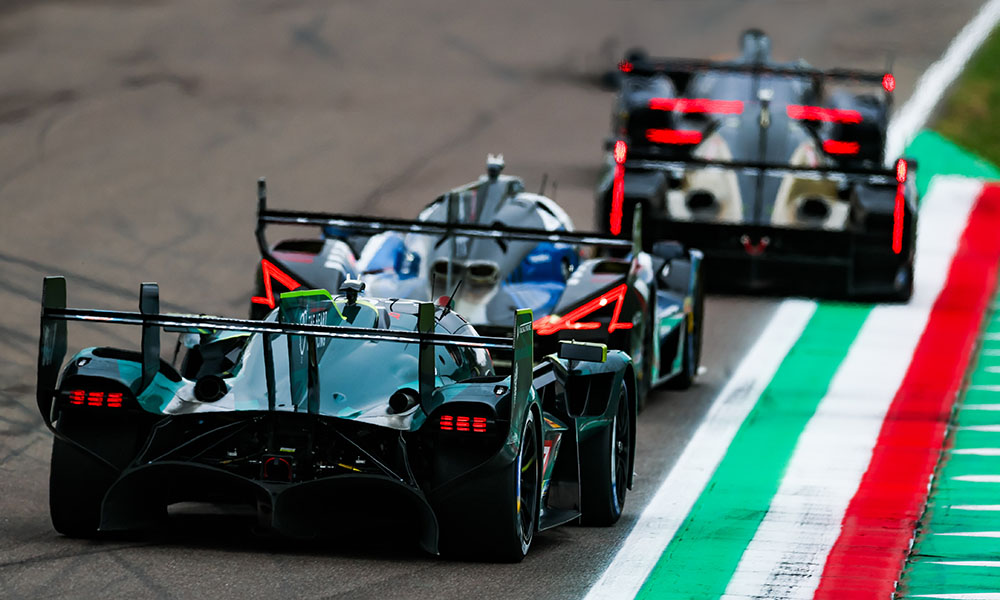
Newly-appointed ACO deputy director of competition Bruno Famin has defended what he describes as a new “black box” approach to Balance of Performance in the FIA World Endurance Championship amid a decision to keep BoP tables out of the public domain.
Famin, who joined the ACO last month after standing down from his previous role as vice-president of motorsport at Alpine, explained that a decision by the ACO and FIA to stop publishing BoP figures ahead of each WEC event, with information about each car’s specification now only shared with competitors under strict confidence.
While WEC competitors have been banned by regulation from publicly discussing or criticizing the BoP for some time, the figures themselves have always been released in the public domain until now.
In a roundtable with selected media including Sportscar365 ahead of this weekend’s 6 Hours of Imola, Famin asserted that outside observers could never fully understand the BoP without knowing the homologation parameters upon which they are based, before a ‘second layer’ is applied using data taken from recent races.
He ruled out the homologation parameters, which were reset this season as every Hypercar visited the Windshear wind tunnel in North Carolina, being made public “for reasons of confidentiality.”
“[The reason] why we don’t publish the [BoP] chart is because it’s super-confusing,” said Famin. “To say we have the same BoP between two cars and that they have the same potential, or the same BoP from one track to another and the figures are different, it’s a bit difficult to handle and to explain.
“We want to avoid any misunderstanding. If you don’t explain to your readers in details [regarding the changes], it’s super-difficult to understand.”
He added: “The thing that we will never publish is the homologation parameters. And if you don’t have the homologation parameters, you cannot understand the figures.
“[We had to consider] what is worse, to publish the chart without [people] having the understanding or not to publish it… we have chosen this way for the time being. I never say never, we may change, I don’t know.
“But if you don’t have the homologation parameters you don’t have the key to understanding the evolution [of the BoP].”
Famin clarified that the BoP system itself in Hypercar essentially remains unchanged from 2025, when race data from a certain number of past events (two, three and each car’s best two of three at various points during the season) was used to make the calculations.
However, the number of races being used and the number of laps — the best 60 percent of race laps as well as the fastest ten laps were used last year — remain unclear.
Much like Aston Martin last year, Hypercar newcomer Genesis will begin with a BoP decided using data taken from the fastest car from each race being considered by the rule makers, which will be gradually replaced by data taken from the GMR-001 as the year progresses.
Famin however refused to clarify whether the 24 Hours of Le Mans will have its own standalone BoP, as it has in previous years, or whether it will now be included as part of the rolling average system.
“It’s a bit too early to comment on that,” said Famin regarding Le Mans. “For the time being we prefer not to answer because there are only two races before Le Mans and we prefer the manufacturers not to know how it will work.”
Pressed further on the matter by Sportscar365, Famin replied: “We want to avoid some of the manufacturers thinking that there will be a kind of rolling BoP in the Le Mans BoP. We want to limit the risks of sandbagging at Imola and at Spa.
“We prefer to keep it as a black box.”
Famin also stated that a reset in homologation parameters for the 2026 season and the introduction of a new range of Michelin tires in Hypercar were not big enough factors to disregard data generated from last season when considering the BoP.
“We know the difference in homologation parameters from last year and they are not huge because the regulations are quite strict,” he said. “For the new tires, it’s still the same manufacturer and they are quite close except for the [visual] design.
“We believe it’s still relevant to consider the previous events in 2025, some of the most relevant events of 2025 in the rolling BoP.”
Despite having been added to the regulations over the winter, success handicaps will not be used in addition to BoP for the time being.
“I think the BoP is complicated enough not to add a third layer [on top of homologation parameters and race data],” argued Famin.
“Of course we looked at all the possibilities, but when you have only eight races in a championship, it becomes a sandbagging championship [if you add handicaps].”



Intercontinental GT Challenge
Yardley: “Incredible” Feeling to Win SRO GT Academy Prize

WeatherTech Championship
13 Autosport Commits to GTD Return With Corvette


Intercontinental GT Challenge
Ratel Explains “Key Element” of Moving U.S. IGTC Round to COTA

Michelin Pilot Challenge
Stallion Targeting Four-Car CUPRA TCR Effort in 2027


Intercontinental GT Challenge
13 Autosport Set for Bathurst 12H Debut; N24 Plans in Works


WeatherTech Championship
Vanthoor Delivers Porsche Penske Win at Petit Le Mans

WeatherTech Championship
IMSA Honors Season’s Best at Night of Champions


Pirelli GT4 America
Watch the Full-Length Replays of Rounds 12 & 13 at Indy

Intercontinental GT Challenge
Watch Highlights of Indy 8H

Intercontinental GT Challenge
Watch the Full-Length Replay of Indy 8H

WeatherTech Championship
Watch the Full-Length Replay of Motul Petit Le Mans