Photo: Julien Delfosse/DPPI
Toyota has suggested that Equivalence of Technology rules could be revived to allow hydrogen-powered cars the chance to compete with conventional Hypercars when they make eventually their debut in the FIA World Endurance Championship.
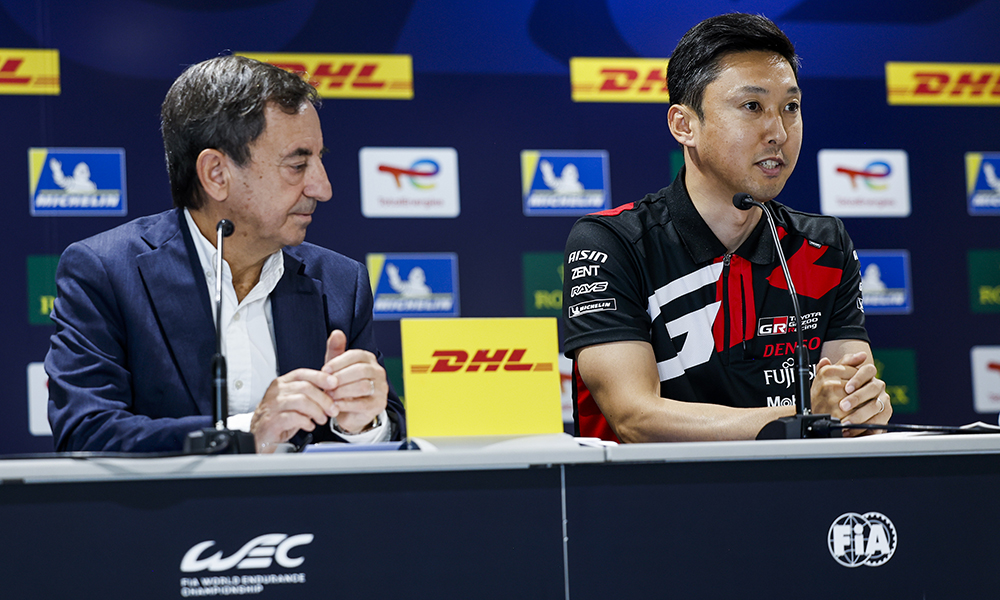
Kazuki Nakajima, vice-chairman of Toyota Gazoo Racing Europe, made the remarks speaking to reporters immediately after a press conference during last weekend’s 6 Hours of Fuji that also featured ACO President Pierre Fillon.
Toyota has long been vocal about its ambitions to one day compete in the WEC and in the 24 Hours of Le Mans with hydrogen power, having pioneered the use of liquid hydrogen combustion technology in Japan’s Super Taikyu series.
However, the fact that the current Hypercar rules have been extended until the end of the 2032 season has raised the prospect that hydrogen cars, currently due to be eligible race at Le Mans for the first time in 2028, may be unable to challenge for victories against conventional cars until new regulations come on stream in 2033.
Fillon suggested during the press conference there would be a “transition period” before hydrogen-powered cars would be able to fight on equal terms.
Asked if Toyota accepts that winning at Le Mans with hydrogen would be difficult before 2033, Nakajima responded by invoking the Equivalence of Technology (EoT) rules previously used to balance gasoline- and diesel-powered cars during the LMP1 era.
“It depends on the technical and sporting regulations,” said Nakajima. “In the past we had EoT between different fuel-based combustion engines.
“We would need something like this. But this is for the governing body to set up all the details, and we need a consensus with other manufacturers as well.
“It’s something we need to discuss together with the organizers and other manufacturers because there are a lot of topics for the future regulations right now.”
Nakajima suggested that Toyota’s existing GR010 Hybrid, which is set for a major refresh next year, will continue to run for many years to come in the WEC alongside any future hydrogen-powered challengers entered by the Japanese marque.
“It depends how many competitors we can have together,” said Nakajima. “We believe by that time [a hydrogen car makes its debut] we will also have the current Hypercar running flat out, hopefully against many other manufacturers.
“As Pierre said, maybe there will be a transition phase, a mixture of Hypercar and hydrogen cars.”
Nakajima also stated that Toyota has no qualms about being the only manufacturer on the grid with a hydrogen-powered car at first, noting that the marque remains the only one to use the technology in Super Taikyu.
“At the end of the day, somebody has to start,” he said. “This is our approach, and anyway in Japan we are always the only one to run a hydrogen car. We are always happy to be a pioneer and challenge new technologies.
“It has to happen step-by-step and if somebody proves that it works, maybe it will help to bring more competitors.”
While the ACO’s target date for the formal introduction of hydrogen regulations remains 2028, Fillon admitted during the press conference for the first time that the first hydrogen-powered cars may not line up at Le Mans until 2029 or 2030.
He clarified that the governing body’s goal is to have technical regulations published by early next year, reiterating that the exact timeline for a hydrogen car to race at Le Mans “depends on when the manufacturers are ready to come.”
On when he envisages a hydrogen car being able to fight on equal terms for victories, Fillon said: “Maybe after 2033 we will have the same regulations in terms of weight. But we need some progress on the weight and the power of the car, and so on.
“The job in terms of the regulator is to bring the two platforms as close as possible.”
At Le Mans this year, Toyota revealed the GR LH2 Racing Concept, the latest symbol of its desire to challenge for overall wins in the French classic with hydrogen.
However, Nakajima was not prepared to provide any update on when the GR010-based prototype many run for the first time when asked by Sportscar365.




GT World Challenge Australia
D’Alberto, Deitz Return Aboard Wall Racing Lamborghini

Porsche Carrera Cup NA
Drivers Give Early Impressions of New Porsche 911 Cup

Lamborghini Super Trofeo NA
TR3 Sets Four-Car Lineup; De La Torre, Bamber Return in Pro

European Le Mans Series
De Gerus In, Blomqvist Out for Two-Driver Inter Europol Lineup

Porsche Challenge NA
Morad’s Chase, Late Pass Gives Endurance Challenge Win to JDX


GT World Challenge America
GTWC America Set for Largest Full Season Grid in Seven Years

Asian Le Mans Series
Ferrari 499P Set to Feature in New Asian Hypercar Class


Porsche Carrera Cup NA
Drivers Give Early Impressions of New Porsche 911 Cup

Michelin Pilot Challenge
Introducing IMSA’s Latest 3D Scholarship Winner Nicky Hays

WeatherTech Championship
Watch the Rolex 24 Sights & Sounds