Photo: SUPER GT
Dunlop does not expect any of its existing GT300 teams to have any kind of advantage in SUPER GT next season when it takes over as the one-make tire supplier for the class.
It was announced earlier this month that the Sumitomo-owned brand had been selected to supply the GT300 division from 2027 onwards as part of a three-year contract, with Bridgestone assuming sole control of the top GT500 class.
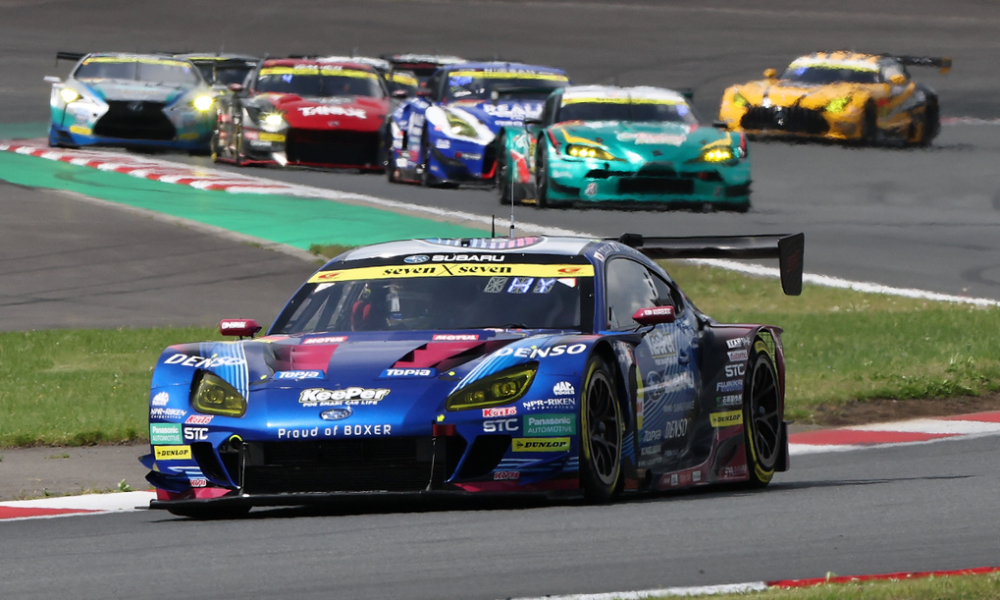
Currently, Dunlop supplies four of the 29 cars active in GT300: the No. 11 Gainer Nissan Z, the No. 60 LM Corsa Lexus LC500, the No. 61 works R&D Sport Subaru BRZ and the No. 777 D’station Racing Aston Martin Vantage GT3 Evo.
Testing with Dunlop’s 2027 products began on the Monday following this month’s Fuji Speedway round and will continue the day following this weekend’s Suzuka race.
Along with Bridgestone, Dunlop will be required to supply Soft, Medium and Hard tire options, although in the case of GT300, only it is likely that only two of the three compounds will be available in each round for teams to choose from.
Discussing the challenges of supplying such a diverse field, including FIA GT3s and SUPER GT’s own GTA-GT300 and Mother Chassis concepts, Dunlop Japan’s motorsport department manager Yoshi Yasuda said that the firm will rely on its experience of using different temperature ranges to satisfy different car requirements.
Yasuda told Sportscar365: “When we design a tire, we consider the weight distribution of the car. Next year, we will have to use a baseline that’s close to the average across all the different cars, and we’re going to supply that kind of tire.
“When you design a tire in that way, it becomes similar to the ‘other’ brand that is already doing a ton of one-make series [Pirelli]. The stiffness balance is close to them. So I think there won’t be a big problem for the GT3 cars.
“Then we have the [GTA-]GT300 cars, some of which are lighter [than the GT3s]. What we are currently do with the cars we supply is to shift the compound; they have a different temperature range and it seems to work well.
“For next year, we will have three different temperature ranges [for Soft, Medium and Hard] and most likely the GT300 cars will use softer ones and the GT3s the harder ones. It doesn’t mean that Soft grips more than Hard; it’s just the temperature range.
“The compounds will be completely different to the current ones, but we know they work because we have already tested them in another series [NLS]. The construction and profile will be similar, but not identical to any car we are supplying now.”
Asked if pre-existing knowledge of Dunlop tires could be an advantage to the firm’s current handful of GT300 teams, Yasuda replied: “I don’t think so. We have to change the compound anyway, and that will have a big impact.
“If the stiffness balance changes, you can’t use the same set-up, so I don’t think there will be any advantage.”
Yasuda added that any remaining imbalances between FIA GT3s and GTA-GT300/Mother Chassis cars would have to be corrected by Balance of Performance adjustments.
Similar measures are set to be used for next year’s Suzuka 1000km, when the Intercontinental GT Challenge event becomes a points-paying GT300 race, to ensure parity between the SUPER GT entrants on Dunlops and the IGTC regulars on Pirellis.
“Our lap time target is to be around one second slower than we are now, but to still be a bit quicker than other series [using GT3 cars],” added Yasuda.
Four different Dunlop compounds were tested at Fuji, including a ‘Hard plus’ with the same temperature range but a higher wear resistance than the regular Hard.
These were tested by three of the company’s existing clients, Subaru, LM Corsa and Gainer, plus LEON Racing’s Mercedes-AMG GT3 Evo and Seven x Seven Racing’s Porsche 911 GT3 R Evo, which currently use Bridgestone and Yokohama respectively.
Testing continues at Suzuka next Monday, with the No. 2 Inging Toyota GR86 GT, the No. 62 Helm Motorsports Nissan GT-R NISMO GT3 and the No. 88 JLOC Lamborghini Huracan GT3 EVO2 all set to try the 2027 Dunlops for the first time.



Lamborghini Super Trofeo
Lewandowski Wins Am/LB Cup Opener Despite Nervy Finish

Lamborghini Super Trofeo
Lind, van der Drift Secure Pro/Pro-Am World Finals Poles

Lamborghini Super Trofeo
Lewandowski Takes Double Am/LB Cup World Finals Pole

Lamborghini Super Trofeo
Monza Weekend Notebook

Porsche Carrera Cup NA
Maxson Paces Lone COTA Practice

Lamborghini Super Trofeo Europe
Gilardoni, Iaquinta Seal Title in Bizarre Circumstances

Mustang Challenge Global Inv.
Mustang Challenge Global Invitational Launched for 2027

WeatherTech Championship
Joint IMSA-SRO Daytona BoP Test Canceled

FIA GT World Cup
New AO Design Part of Four-Car Porsche Macau Assault

FIA GT World Cup
Bamber Makes Surprise Macau Return With Audi

GT World Challenge Europe
Engel, Auer Take Overall Drivers’ Title After DSQ Appeal

FIA GT World Cup
Aston Martin Returns in 18-Car Entry, Fuoco Won’t Defend Win

WeatherTech Championship
IMSA Endurance Hour Podcast: Ep. 41: Hall of Fame Drivers


WeatherTech Championship
Watch NBC’s WeatherTech Championship Season Review

WeatherTech Championship
IMSA Endurance Hour Podcast: Ep. 40: Foley, Auberlen & More