Photo: Andrea Lorenzina/DPPI
Ferrari has outlined the additional ‘cost and effort’ involved in coming up with two different logistical plans amid uncertainty over the conclusion to the FIA World Endurance Championship’s schedule.
The conflict in the Middle East had already forced organizers to postpone the planned Qatar 1812km season-opener from March to October.
But the continuing war placed doubt over the rearranged date and also the Bahrain season finale in November, with championship officials producing a backup plan that would involve the final two events instead taking place in Europe, understood to be at the Circuit de Barcelona-Catalunya and Monza venues, as first reported by Sportscar365 last month.
A final decision over which calendar scenario will be chosen is expected to come by next week when it is presented to the FIA World Motor Sport Council for approval.
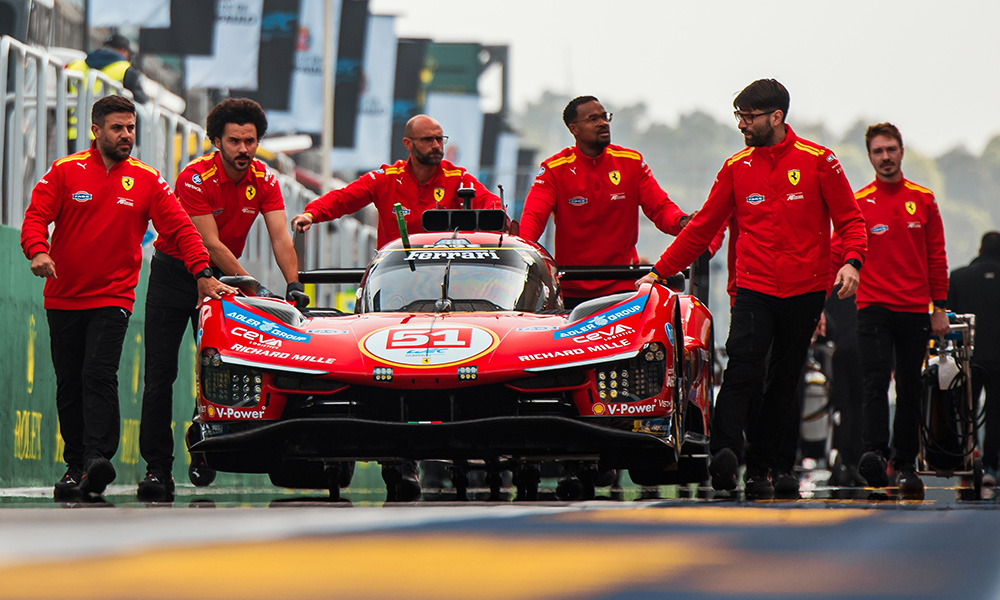
Ferrari AF Corse team manager Batti Pregliasco detailed how the uncertainty had forced teams to create contingency plans for transporting their equipment so they were prepared for both situations.
“I think every team has, together with the [series] organization and DHL, made already a ‘Plan B’ with double kits of material,” said Pregliasco when asked by Sportscar365 in Brazil about the challenges of the schedule limbo beyond the September Lone Star Le Mans and 6 Hours of Fuji events.
“For example, we have sent some material here that will go to Fuji directly and we keep the second kit that will go to Austin and [then] standby to know if we go to Qatar, Bahrain or to Europe because it’s the only way by container, by sea freight to go in both areas safely and without having some blocks on the shipping lines, so we already anticipated some problems.
“Of course, it’s a cost, it’s an effort, but we already spoke and work on these two plans to make it happen.”
The uncertainty over the final two venues also meant teams were unsure about the number of points on offer.
With both Middle Eastern races being held over longer distances, extra points were traditionally available at both of these.
However, with European contests in October and November coinciding with colder temperatures, changeable weather conditions and shorter daylight hours, it’s believed that the ten and eight-hour race lengths would be scrapped for normal six-hour rounds if run in Europe.
Other Asian venues could have potentially presented the chance to maintain the longer distances, but Pregliasco said this would have been problematic as well.
“To go to other places like Sepang, China or whatever else, then you face the same problem of the logistic transportation, the huge cost and basically if you’re in Austin then you have to ship the material by air freight and maybe it will be blocked somewhere,” he explained.
“It’s a geopolitical problem that is more important than what is our job and our decision to be here, there or there — we need to think that safety is the priority for everybody.
“And to be stuck, like we had the risk this winter time in January/February with all the containers in Bahrain, Qatar [for testing and ahead of the planned season-opener] and they cannot come back and you risk to delete Qatar, Imola and Spa and destroy all of our jobs, all the effort and investment of Ferrari, it’s more important to keep the championship alive than take risks.”
Pregliasco said Ferrari ‘loves’ the two circuits that were originally scheduled to conclude the season, adding: “They’re tracks we’re competitive at all the time.”
However, a European end to the campaign would leave fewer points on the table for Ferrari to try to close the deficit to Toyota and BMW in the Hypercar manufacturers’ title race.



Porsche Carrera Cup Asia
Giltrap Beats Amand to Title After Double Singapore Win

Toyota GR Cup NA
Colby Makes History; Kohlbecker Clinches Title in Race 2 at Indy

Pirelli GT4 America
Muniz: “Feels So Good” to Earn First Championship With Ford

Pirelli GT4 America
Pumpelly: “Karma Caught Up” for RS1 to Win Silver Title in Pits

European Le Mans Series
Indy NXT Racer Kucharczyk Stars in Portimao Rookie Test

GT America
Dempsey Sweeps Weekend in Maserati GT2

Intercontinental GT Challenge
Finalized Indy 8H Entry List Released; DragonSpeed Out

Intercontinental GT Challenge
13 Autosport Set for Bathurst 12H Debut; N24 Plans in Works

WeatherTech Championship
Lamborghini GTD Pro Program Unclear for 2027

WeatherTech Championship
Vanthoor Delivers Porsche Penske Win at Petit Le Mans

Michelin Pilot Challenge
Circle H Wins; AutoTechnic Takes GS Title at Road Atlanta


Intercontinental GT Challenge
Watch Highlights of Indy 8H

Intercontinental GT Challenge
Watch the Full-Length Replay of Indy 8H

WeatherTech Championship
Watch the Full-Length Replay of Motul Petit Le Mans

Toyota GR Cup NA
Watch Full-Length Replays of Rounds 11 & 12 at Barber

Porsche Carrera Cup NA
Watch Full-Length Replays of Rounds 13 & 14 at Road Atlanta