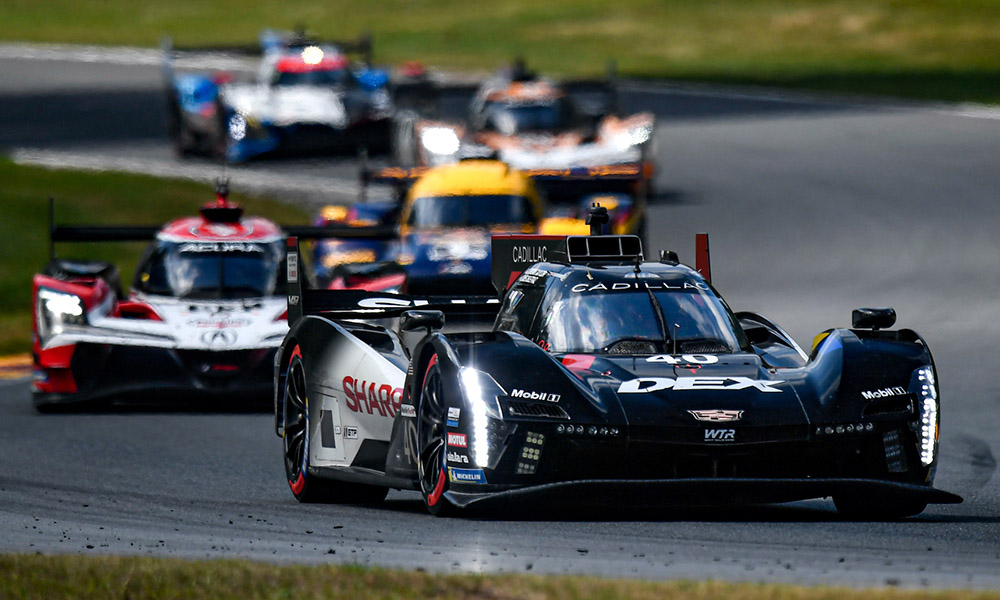
Photo: Brandon Badraoui/IMSA
IMSA is currently investigating “technology” that could “complement” and “improve” the amount of yellow flag time in races according to the sanctioning body’s senior vice president of competition Simon Hodgson, who indicated that testing has already been carried out with selected teams.
The potential development in a change, or an additional option to the race neutralization process comes in the wake of a recent trend of lengthy full-course caution periods, most notably in four-class WeatherTech SportsCar Championship races, when the prescribed safety car procedure could take upwards of 20 minutes on longer circuits.
While acknowledging a change to this year’s sporting regulations that ‘short yellows’ are deployed for the during the first 30 minutes of each race, and subsequently within 15 minutes following a restart, Hodgson indicated that further time-saving measures could be used in the future.
“We’ve tried to take a progressive approach in consideration that one of the things when we actually don’t have a lot of yellows that people support is the full course yellow process, because maybe they had a potential issue earlier in the race. [A] full course yellow process allows them to get back on to the lead lap,” he said.
“In a lot of cases, you’re all way at the back and now you’re at the front racing for the win and have won in some instances. So we’ve got to find that balance.
“Where this naturally gets amplified is when you go to a long track, which is what we saw at Road America. We saw these processes. Short yellows, full-course yellows, taking between 15 and 20 minutes.
“We’re very cognizant of that.”
Sportscar365 understands that one of the possible measures being explored is a virtual safety car, where competitors reduce speeds for short interventions, typically lasting one lap or less, which would allow for quick actions from corner workers, such as the cleanup of debris.
This measure, made famous by Creventic nearly 20 years ago in what the Dutch organization calls ‘Code 60′, is known as a Full Course Yellow (FCY) in the FIA World Endurance Championship.
It’s activated by the race director, with the specific timing transmitted to each car through radio and an on-board marshaling system, with cars’ speeds tracked by GPS monitors.
Hodgson, however, wouldn’t confirm that any specific measure is under consideration at this time.
“We have been looking at different kinds of technology and we’re carrying out some testing with select teams,” he said.
“The idea is to try to utilize technology moving forward in a way that might be able to complement and improve some of these situations.
“But we’ve also got to be cognizant of the fact that IMSA is made up of the amount of things it is, and technology costs money.
“For sure, that is something happening in parallel. But at the same time, we’re also interrogating our own regulations as well to try to find that balance between the two.”
Hodgson: Drivers “Need to Improve” to Prevent Yellows in First Place
While IMSA is looking at methods of continuing to streamline its yellow procedures, Hodgson stressed that drivers need to up their standards in order to ensure more green flag running.
“For sure, we’re not standing still,” he said. “Every week we’re having debriefs, we’re discussing these things.
“We will improve, but the drivers need to [also] improve. We cannot be having this series of full course yellows before the race has actually got into a groove.
“I think the longest green flag stint at Road America was about 1 hour and 20 minutes. That was probably after the first two or three full course yellows.
“We’re not accepting ten minutes, just getting the race going, and then we have incidents. It’s not what the people paying for, not the sponsors are paying for.
“It’s not why any of us are in the racing business.
“We’ve got a great product. Everybody needs to participate, collaborate in moving that product forward to the necessary level and standard that we see in most circumstances.
“So, that’s on myself, IMSA race directors is to communicate that in a consistent manner, consider the penalty structure [and] make sure we’re not jumping outside of that and take a measured and scaled approach.”




European Le Mans Series
Title Contender Masson Again Quickest in Portimao FP2

GT World Challenge Europe
Six WEC Drivers Also on 61-Strong Portimao Entry List

GT World Challenge Europe
Car Collection Motorsport to Enter Porsche at Portimao


Porsche Carrera Cup Asia
Joint Carrera Cup Asia/Japan Fuji Round on 2027 Calendars

Intercontinental GT Challenge
Palou Joins Lone Star Racing for Indy 8H Return


Asian Le Mans Series
Two Hypercars on 47-Car Full Season Entry List


WeatherTech Championship
AO to Run Skeleton Rexy, Rockie Characters at Petit Le Mans

Intercontinental GT Challenge
British GT’s Waberski First To Seal SRO GT Academy Win

WeatherTech Championship
Watch the Full-Length Replay of Motul Petit Le Mans

Toyota GR Cup NA
Watch Full-Length Replays of Rounds 11 & 12 at Barber

Porsche Carrera Cup NA
Watch Full-Length Replays of Rounds 13 & 14 at Road Atlanta

Michelin Pilot Challenge
Watch the Full-Length Replay of Fox Factory 120

WeatherTech Championship
Watch Extended Highlights of Motul Petit Le Mans