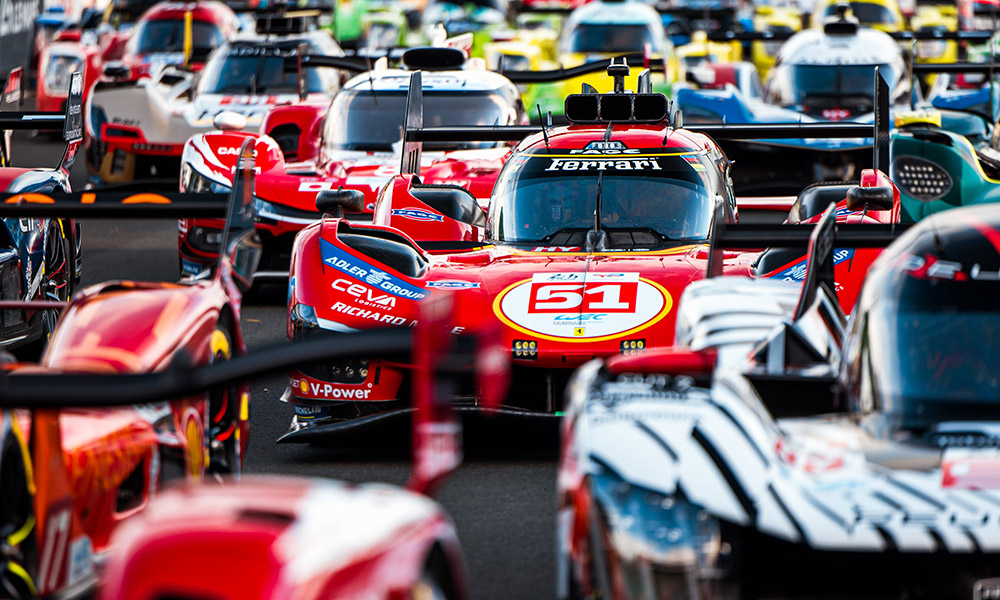
Photo: Andrea Lorenzina/DPPI
Ferrari has launched a strident defense of the LMH platform in the FIA World Endurance Championship as talks surrounding the future of the Hypercar regulations near their conclusion, stating it cannot be held responsible for higher-than-expected costs.
The Italian manufacturer’s head of global endurance Antonello Coletta set out his organization’s position amid the struggle to find compromises between the LMH and LMDh rulesets in a bid to create a unified framework for 2030 onwards.
It comes ahead of the ACO’s annual press conference at the 24 Hours of Le Mans on Friday, where further details on the new rules are expected to be revealed.
Ferrari, which has committed to Hypercar through to the end of the current regulations cycle in 2029, has always been consistent in its belief that it must retain the ability to build its own chassis and utilize its own custom hybrid system.
Coletta reiterated on Wednesday at Le Mans that “clearly the Prancing Horse has to be built 100 percent in Maranello” as he took aim at those LMDh manufacturers which he says have been surprised that costs were higher than they first expected.
“[Hypercar] has been established for some years, we’ve lost some manufacturers on the way, but so far nobody (no major OEM) has left from the LMH platform,” Coletta said.
“The issue of costs should be tackled seriously and not with cliches, or rough ideas simply to hit the headlines.
“When I see people complaining about [Evo] jokers, this is in the regulations. If we decide to compete in a championship, we know what the rules are, and you develop a business plan including the development costs. This is nothing new.
“Building cars with common parts doesn’t necessarily cost less. If you have a contract with a supplier, and if you want to develop a component with that supplier and that you may also have a collaboration with road cars, you may get better costs.
“For our project, which uses the LMH platform, it’s not more expensive than other competitors using the LMH platform. For me the problem is a different one.
“Making strategic decisions, explaining to top management what the costs will be is very important.
“Instead of just submitting ideas or situations that are not exactly true and you find surprises at a later stage — we have to fine-tune the car, otherwise we’re not competitive [or] it’s too expensive — this is not the right strategy.
“I think endurance racing is going through one of its best ever moments, but there’s always a boom and then a fine-tuning phase. We’ve now come to that phase.
“It’s time to understand who wants to continue on this path, without blaming others. You have to be aware of your own decisions and strategies.
“We all have our own targets and aims, whether its strengthening the brand or gaining experience for road cars. You have to make precise decisions without lying to yourself, otherwise you will not be able to defend those decisions.”
BMW: “We’ve Reached the Maximum” We Can Endure on Costs
Representatives of the three existing LMDh brands that are set to race in the WEC in 2027, BMW, Cadillac and Genesis, all struck similar tones when polled by Sportscar365 for their latest thoughts on the 2030 regs.
BMW M Motorsport director Andreas Roos insisted that the Bavarian marque, which leads the WEC standings heading into Le Mans after its breakthrough 6 Hours of Spa win last month, is already at the “maximum” it can endure in terms of costs.
“Looking at the automotive industry, looking at the economic [situation] outside, we just have to read the news everyday and we have to make sure that we’re not forced to spend more money or that something is getting more expensive,” said Roos.
“In the end, it’s about the investment, how much you invest, and how much you can afford to invest. I think especially in the situation we’re in at the moment, on the economic side, we’ve reached the maximum of what we can do.
“I can only hope and say that we get to a regulation that leads to maybe even a reduction of costs and has a very sustainable cost-efficient regulations.”
Roos, however, is not against manufacturers being allowed to develop their own chassis and hybrid systems, as Ferrari, Toyota and Peugeot currently do.
“I think it’s possible, as long as the other way, how we do LMDh at the moment, is still possible,” said Roos. “But we will most likely not [eliminate] BoP or anything because there must be a correcting factor on top of this.
Cadillac Racing program manager Keely Bosn echoed Roos’ views in terms of the desire to eliminate as much difference as possible between LMH and LMDh.
“The hope there is to come down to a single platform, which I think has been the effort like we’ve seen over the last couple years to get to,” Bosn told Sportscar365. “As far as I can see, that’s going to be the direction.
“That’s the hope on Friday, that they come out and give us a little bit more restriction down to the one platform and a little bit more leeway in other areas.”
When asked if Cadillac would be in favor of developing its own hybrid system, Bosn said: “That is something we’d be open [to]” and added that “I don’t think we’re too worried” about any resulting increasing in costs from such a switch.
“I know one of the main things going into the regulations has been to try and keep costs down for manufacturers,” she said.
“Racing is always expensive but we have had that promise from the the FIA and ACO that we’d be looking to try to maintain costs.”
Cyril Abiteboul, team principal at Genesis Magma Racing, meanwhile stated that the “general direction to simplify, to converge” is “essential” while expressing a desire for a balance between cost control and retaining some technological freedom.
“We’re here for marketing, for [the] brand, but also technology for sure,” said Abiteboul. “I think we’ve got a duty all together to make sure that this sport still stands for technology and development.
“We also need to be careful about costs. That’s where we need to be balanced in what we do. On our side, it should not be a technology arms race. But there should be some technological freedom when it makes sense.
“I’m not talking about technological freedom everywhere. I think the job Formula E does on its own space is good, with lots of freedom in certain areas, lots of restrictions in the other areas.
“In my opinion, the best return on investment right now is actually coming from Formula E. Except it doesn’t work for us because that’s not what we want.
“What I’m saying is what they do for EV technology, in my opinion, is good inspiration for what we’d like to do for other type of technology here, with good old [internal combustion engine] racing.”
John Dagys contributed to this report



Porsche Carrera Cup NA
Maxson Paces Lone COTA Practice

Lamborghini Super Trofeo Europe
Gilardoni, Iaquinta Seal Title in Bizarre Circumstances

Lamborghini Super Trofeo NA
Touchette “Never Expected” LB Cup Title in First Season

Lamborghini Super Trofeo NA
Bamber Controls Final Race, Ericsson Fights to Second

WeatherTech Championship
IMSA Endurance Hour Podcast: Ep. 41: Hall of Fame Drivers

Lamborghini Super Trofeo NA
Champion De La Torre Seeks to Build Lamborghini Career

Mustang Challenge Global Inv.
Mustang Challenge Global Invitational Launched for 2027

Porsche Carrera Cup NA
Entries Open for 2027 Carrera Cup Season

WeatherTech Championship
Joint IMSA-SRO Daytona BoP Test Canceled


FIA GT World Cup
New AO Design Part of Four-Car Porsche Macau Assault

FIA GT World Cup
Bamber Makes Surprise Macau Return With Audi
WeatherTech Championship
IMSA Endurance Hour Podcast: Ep. 41: Hall of Fame Drivers


WeatherTech Championship
Watch NBC’s WeatherTech Championship Season Review

WeatherTech Championship
IMSA Endurance Hour Podcast: Ep. 40: Foley, Auberlen & More