Photo: Julien Delfosse/DPPI
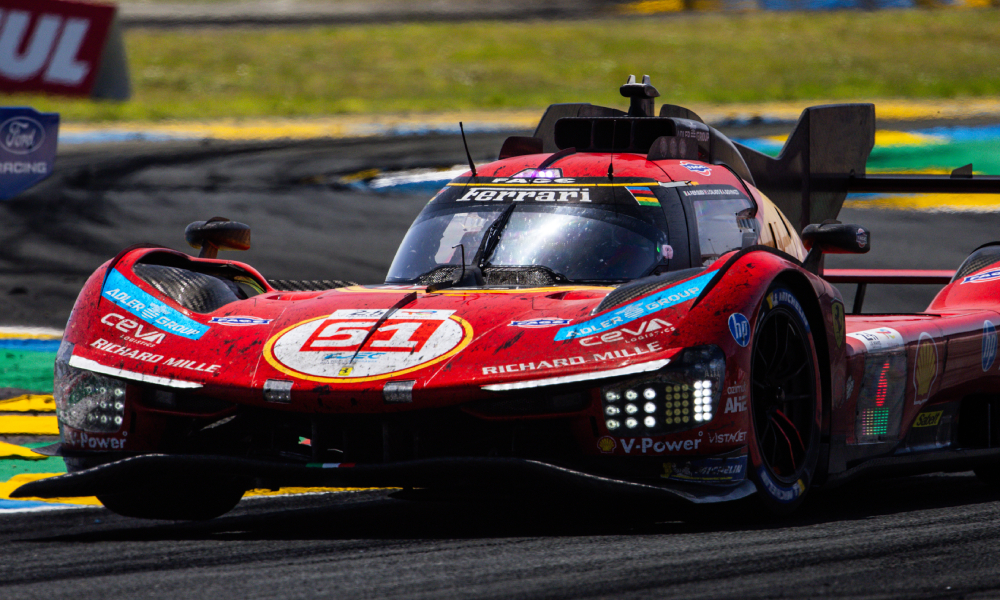
Ferrari’s performance and regulations manager Mauro Barbieri has expressed satisfaction that the best of the Italian marque’s cars finished fifth in the 24 Hours of Le Mans with only the “fourth or fifth” strongest package in the Hypercar field.
The Prancing Horse’s unbroken run of success in the FIA World Endurance Championship blue riband over the past three years with the 499P came to an end last Sunday as Toyota instead scored its first win since 2022 with its upgraded TR010 Hybrid.
Ferrari’s best finisher was the No. 51 car of Alessandro Pier Guidi, James Calado and Antonio Giovinazzi that finished fifth, 2 minutes and 22 seconds down on the winner, behind both Toyotas and the respective best cars from Cadillac and BMW.
The No. 50 Ferrari dropped out with a terminal electrical problem, having already dropped well off the lead lap after a fire extinguisher had to be replaced, while the satellite No. 83 AF Corse entry that won in 2025 was seventh, behind the lead Alpine.
Barbieri described the Hypercar field as “unbalanced from day one” in reference to the test day, and said it knew it stood no chance of fighting Cadillac, BMW or Toyota on pace alone, putting Ferrari’s performance on a rough par with that of Alpine.
“Since the test day, we saw that there were seven cars that were ahead, and probably two more considering the Alpines,” said Barbieri. “So the fact that, instead of finishing P10, we finished P5 with our best car, tells us we did the best we could.
“We had the fourth or fifth-best car. We were in the ballpark with Alpine and the last six hours of the race showed that, because we ran at a similar pace as the No. 35 Alpine, which in the end was able to overtake the No. 83 car.
“The cars ahead of us at the end were a step ahead and we couldn’t catch them.”
Barbieri clarified that Ferrari’s time loss was not coming from top speed but rather in acceleration, with its lap time deficit coming “mainly in slow corners”.
Despite a lack of raw speed to live with the best Hypercar runners, Barbieri said he was pleased at the relative lack of penalties given to the three Ferrari crews compared to last year’s race, having made an effort to work on this during the winter.
Pier Guidi earned the only penalty for either of the works 499Ps when he collided with Jonas Ried’s Proton Competition LMP2 in the evening hours, while the No. 83 car was given a five-second pit stop penalty for an unsafe release and later a drive-through as a result of Robert Kubica speeding in a slow zone.
“I think we put a bit more importance on this [not picking up penalties] compared to the past,” said Barbieri. “We stressed to the drivers that the less time we lose with penalties, the easier it is to score points and be up ahead.
“If you take a drive-through penalty or even five [additional] seconds on the pit stop, to gain that amount of time back on pace is a nightmare.
“We analyzed last year’s race case-by-case over the winter. It’s something we stressed as a team to make another step forward, to improve as a group. That’s why we try to keep doing, to learn from every event and get better every day.”
Barbieri said that Toyota’s strong performance came as no surprise to the Ferrari, suggesting that the Japanese marque’s performance last year, when it struggled with a lack of straight line pace with its previous GR010 Hybrid, was the real outlier.
“I think they showed that pace already from test day,” said Barbieri. “I was more surprised by Toyota’s race last year that was very bad and I was very sorry for them.
“Coming here we were aware that the Toyota of last year was, for whatever reason, not the real Toyota and that they would be top performers, and it was the case.”
Toyota seized the initiative early in the race despite qualifying deep in the Hypercar field, cutting short the first stint of both its cars to gain track position, which allowed the No. 8 car of Sebastien Buemi to build a significant early lead.
However, Barbieri believes that Ferrari would have not ultimately benefited it had elected to try something similar as it lacked the raw speed of the Toyota.
“The strategy that Toyota did is correct and very powerful if you have the pace in clean air,” said Barbieri.
“We believed the best way to close the gap was to run in our rivals’ slipstream. That’s what we were hoping for but after a few laps we couldn’t stay with them.”
On Ferrari’s extensive use of the Hard tire in the closing stages, Barbieri said: “For us it was clearly the best tire compound with 50 degrees [C] of track temperature.
“Having run here almost a week, we could mix and match and test different conditions, and it was clear what were the best tires for our car.
“We also had No. 50 running different tire specs and collecting information, so I wouldn’t blame the tire choices we made. They were the best for our car.”



Intercontinental GT Challenge
Tsunami RT Locks in Second Bathurst 12H Attempt


Nürburgring Endurance
German OEMs: Nordschleife Must Preserve “Full Spectrum”

24H Le Mans
Action Express Ramping Up for Le Mans Return

Mustang Cup Australia
GWR Expands to Second Entry for Woods at Sandown

GT World Challenge Asia
Shanghai Finale Attracts 19 Cars; Heinrich Rejoins Lu

Lamborghini Super Trofeo
Temerario Super Trofeo Set for Early 2027 Deliveries

WeatherTech Championship
Inception Switches to Corvette for 2027 GTD Campaign


Michelin Pilot Challenge
IMSA Shifts Pilot Challenge Testing Off 2027 Roar Weekend


GT World Challenge Europe
GT World YouTube Channel Gets 9.7 Million Views for Portimao

Lamborghini Super Trofeo NA
Watch Full-Length Replays of Rounds 11 & 12 at Monza

Porsche Carrera Cup NA
Watch Full-Length Replays of Rounds 15 & 16 at COTA

WeatherTech Championship
IMSA Endurance Hour Podcast: Ep. 41: Hall of Fame Drivers


WeatherTech Championship
Watch NBC’s WeatherTech Championship Season Review