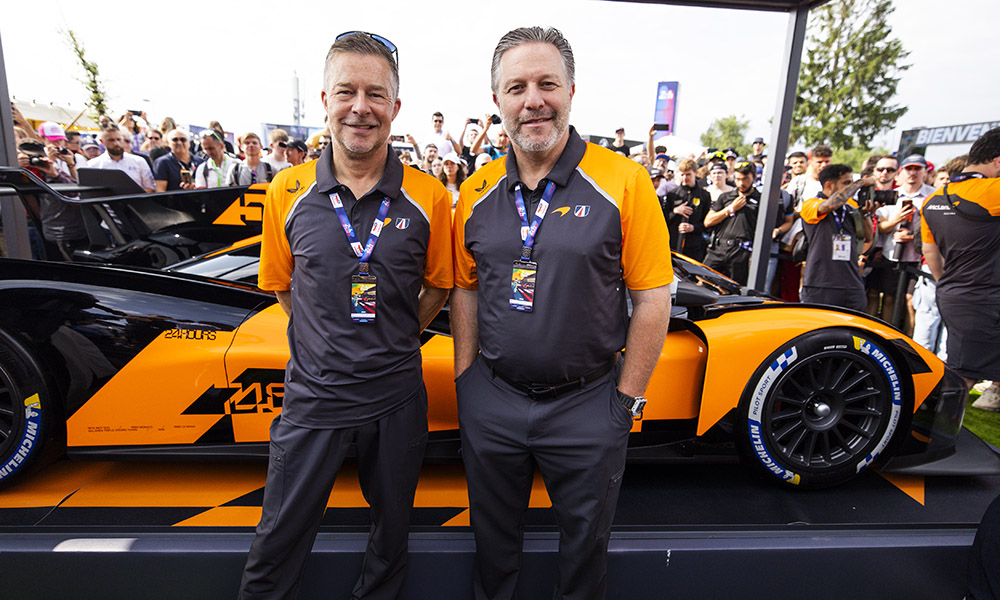
Photo: Julien Delfosse/DPPI
Zak Brown has admitted that McLaren could be forced to push the debut of its prototype effort in the IMSA WeatherTech SportsCar Championship to 2030 if the new regulations are significantly different to the current LMDh ruleset.
The British manufacturer, which will campaign two McLaren MCL-HYs in the FIA World Endurance Championship beginning next year, had previously stated it won’t enter the GTP class of the WeatherTech Championship until 2028 at the earliest.
While still not ruling out a debut in that timeframe, a number of potential complications, including the launch of the new Indy car that same year, and uncertainty over the shape of the FIA and ACO’s next-generation top-class rules, has left McLaren with more questions than answers.
Speaking with Sportscar365, Brown said one of the other key deciding factors would be whether its possible WeatherTech Championship effort would be run by its NTT IndyCar Series team, Arrow McLaren, or WEC Hypercar partner United Autosports.
“If we raced IMSA, we’re not sure yet how we would do that,” he said. “Do you do it with United or do you do it with [Arrow McLaren]? We’ve got the space and the capacity [at Arrow McLaren]. [But] we don’t have the people sitting around.
“The only thing, if we were to do it in ’28, you’ve got the new Indy car coming then. If you got into a scenario where McLaren was doing it and you’ve got the new Indy car, that’s a lot of stress on the system.
“If you went the route like we’ve done in Europe where you have United, then the fact that the IndyCar team has new cars in ’28 is irrelevant.”
However, Brown said should they decide to take the IMSA program in-house, at its new 86,000-square-foot McLaren Racing Center in Indianapolis, it could theoretically delay the GTP effort to 2029.
“Then if you go to ’29, you get into it with the new rules coming out for ’30,” he said. “You also run up, depending on what the rules are, it could be expensive to [run to] the old rules for one year.
“You’ve got to build, then you’re changing again next year, so then you get to a point of ‘Well if you can’t get a few years out of this car, you’re better off waiting until the new car.’
“But again, that depends on what the rules are.”
Brown said a decision on a possible WeatherTech Championship program would need to be taken by early next year if it were to enter the following season.
“We can’t decide much later than the start of ’27 because of the gear-up time,” he said. “But it would be good to get our feet wet a little bit in WEC to see where we are, are the budgets what we think they are?
“There is a lot of budget creep. I’m not a fan of all this Evo [joker] stuff. It’s just getting more and more expensive.
“I think we need to assess where we are, know what the rules are by then and then take a view.”
Brown Wants 2030 Regs to Be Carryover of LMDh
When asked what he would like to see out of the 2030 top-class regs, which is understood to still be a talking point amongst manufacturers, Brown said he’d want to essentially see an extension of the current LMDh rules, but with further cost controls.
“Get rid of LMH, [base it on] LMDh and then I think as little change as possible,” he said. “I wouldn’t want to see anything that’s more expensive because I think it’s more expensive than I anticipated.
“From what it was initially presented five years ago, it’s doubled [in cost]. You’d expect [some increase]. The problem is that we’re playing to win, so spending less isn’t an option.
“Then why do it? Cost containment, you do that through things like [no] Evos and carry over the spine, that type of stuff, I think is pretty critical.
“We have to self-fund the program through sponsorship, and that’s also another thing.
“We’re doing pretty good on WEC right now. We’re not where we need to be but we’re we need to be at this particular moment in time.”
Brown said he’s “definitely” worried costs in the top-class could spiral out of control if significant changes are made for 2030, although stressed that a cost-cap model, similar to Formula 1, wouldn’t work in sports car racing.
“It costs a lot of money to police as well and is very full-time,” he said. “I get it in F1 but IndyCar has done a good job in cost containment by the regulations.
“You can’t spend more money in IndyCar even if you wanted to. You’re not allowed to test, a lot of stuff is spec, so you’re kind of stuck.
“I think using Balance of Performance, getting rid of Evos, locking stuff down… It’s all the development that costs money.
“In IndyCar, we’re allowed a couple of days of testing. You just literally can’t spend more money even if you wanted to.
“And it looks to me that IndyCar is less expensive to run than sports cars.”



Lamborghini Super Trofeo
Monza Weekend Notebook

Porsche Carrera Cup NA
Maxson Paces Lone COTA Practice

Lamborghini Super Trofeo Europe
Gilardoni, Iaquinta Seal Title in Bizarre Circumstances

Lamborghini Super Trofeo NA
Touchette “Never Expected” LB Cup Title in First Season

Lamborghini Super Trofeo NA
Bamber Controls Final Race, Ericsson Fights to Second

WeatherTech Championship
IMSA Endurance Hour Podcast: Ep. 41: Hall of Fame Drivers

Mustang Challenge Global Inv.
Mustang Challenge Global Invitational Launched for 2027

Porsche Carrera Cup NA
Entries Open for 2027 Carrera Cup Season

WeatherTech Championship
Joint IMSA-SRO Daytona BoP Test Canceled


FIA GT World Cup
New AO Design Part of Four-Car Porsche Macau Assault

FIA GT World Cup
Bamber Makes Surprise Macau Return With Audi
WeatherTech Championship
IMSA Endurance Hour Podcast: Ep. 41: Hall of Fame Drivers


WeatherTech Championship
Watch NBC’s WeatherTech Championship Season Review

WeatherTech Championship
IMSA Endurance Hour Podcast: Ep. 40: Foley, Auberlen & More