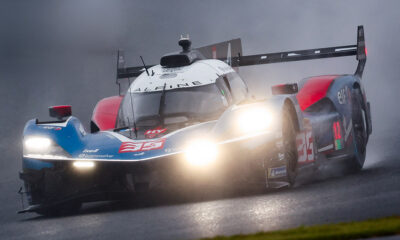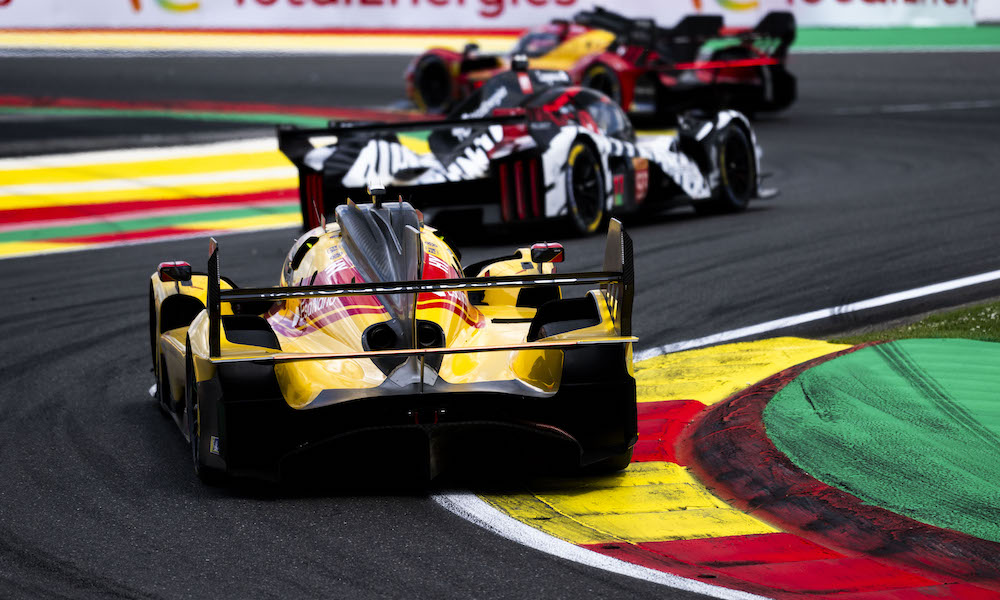
Photo: Fabrizio Boldoni/DPPI
Ferrari’s global head of endurance Antonello Coletta has argued that Balance of Performance should not be a part of the 2030 FIA World Endurance Championship Hypercar regulations that are in the process of being finalized.
The broad concept of the next generation of Hypercar rules was outlined at this year’s 24 Hours of Le Mans with a single platform being adopted whereby all manufacturers would need to run a rear-wheel-drive car.
The initial proposals stated that brands would have the choice to either use a registered constructor’s complete spine alongside common parts like a hybrid system, in a similar way to the current LMDh rules, or they will have the opportunity to develop their own chassis and hybrid system.
Coletta describes the creation of the 2030 rules as a “very good opportunity” to eliminate the complexities of the LMH and LMDh cars competing alongside each other and has called for BoP to either be removed entirely or to be far less wide-ranging than it is at present.
“Now we are around the table all together to define a unique platform and with a unique platform we can write the rules very clear and the final goal should be for us to delete the BoP,” he explained.
“If you remember, the BoP was born with the different platforms — four-wheel drive, two-wheel drive, LMDh, LMH — but if we have a unique platform I think you can have a very, very good chance of positioning the championships around the table with a meritocracy without discussion every race about the BoP and so on.”
This is not the first time Ferrari has called for BoP to be removed, having previously done so last year amid criticism of the revised system introduced for 2025.
Coletta described the removal of BoP as being “the dream” for Ferrari but acknowledged that all the different manufacturers have varying priorities and compromises would be required.
While he said the removal of BoP was “not mandatory” in order for the Italian manufacturer to continue in the WEC into the next rules cycle, Coletta did add there were other red lines.
“For us it’s mandatory to have the chance to make the car,” he said.
“The idea of Ferrari is to have a unique platform with rules very strong with the chance to make the car with our efforts, not to share the gearbox or electronics or some parts.
“If other manufacturers have a dream to share some mechanical parts, then why not.
“We prefer to put our Horse (logo) in front of the car if the car is a Ferrari not if it’s 80 percent a Ferrari, five percent another manufacturer, another five another one.
“After, if we can make 100 percent of the car, we will see the BoP or the little BoP. The discussion is very complicated, very open.
“Today we have BoP but if we have a little percent of the intervention it should be a solution — we need to have a marginal intervention, not a lot. Our idea is to delete completely or just have a little.”
Coletta also stated it would be Ferrari’s preference to be able to continue with a four-wheel-drive platform, particularly with its greater relevance to modern day road cars, but said that was not a deal breaker.
That view was less hard line compared to fellow LMH manufacturer Toyota, whose global motorsport director Masaya Kaji said in the aftermath of the initial 2030 rules proposals being announced that it would be “painful to accept” not being able to retain four-wheel drive.
“For us, it makes sense for us to have four-wheel drive because all the street cars go ahead in this direction but, when you are around the table you need to lose some issues and gain the other one,” said Coletta.
“For Ferrari to have four-wheel drive would probably be the best, but apart from Ferrari and two other manufacturers, this is not of interest for the rest. It’s clear it would be complicated to maintain the four-wheel drive (in the rules).”




FIA WEC
Watch WEC’s Monza Preview


WeatherTech Championship
Porsche Not Expecting Any More “Big Updates” to 963


FIA WEC
Watch WEC’s Monza Preview


WeatherTech Championship
IMSA Endurance Hour Podcast: Ep. 42: Aitken & Bamber