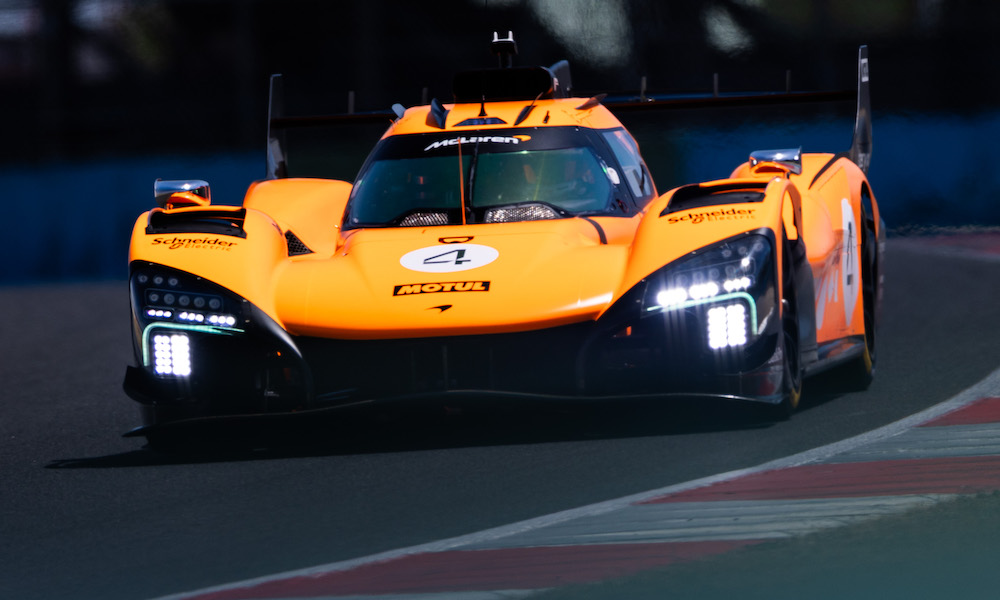
Photo: Drew Gibson
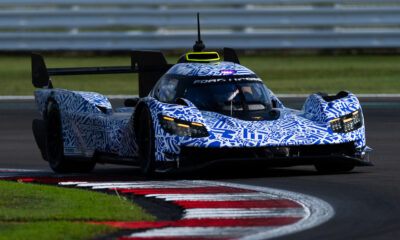
McLaren Endurance Racing team principal James Barclay has described a “great buzz” in the squad after it has already completed a successful 30-hour test of its new MCL-HY Hypercar at Motorland Aragon — an achievement Mikkel Jensen admitted was “more than we expected.”
The new car was given an initial rollout at Varano in early May, but following just two subsequent tests at Imola and Magny-Cours — where the MCL-HY had already completed an entire six-hour FIA World Endurance Championship race distance — it went straight into the Aragon endurance test last month.
Although there were some brief stoppages, mainly to check on potential problems suggested by sensors, there were no major halts as preparations intensify ahead of the car’s scheduled 2027 WEC debut.
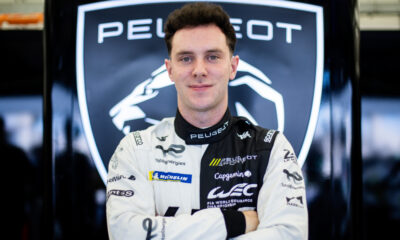
Compared to his time developing the initial Peugeot 9X8 Hypercar, Jensen said he was pleasantly surprised by how quickly McLaren had progressed to lengthy endurance tests.
“I can only judge from the past and we had big beliefs we could do endurance testing but it took a long time before it worked out,” he said at McLaren’s latest Silverstone test.
“I was quite surprised [by the McLaren mileage]. Traveling to Aragon, you never know what to expect, it’s your first endurance test. But it was very, very positive with the outcome and very impressed with the team with everything they’ve done.”
Barclay said it was important that McLaren “stressed ourselves early” to establish if there were any major reliability concerns with the MCL-HY.
“There are other competitors who are using known engines and other known parts that have been used in other applications — whether it’s GT3 or other things,” he explained.
“Our development journey in one sense has a bit more to do so we wanted an endurance test quite early just to see if fundamentally we had something that we needed to address.
“So that was the really positive side because we’ve shown we have some inherent reliability — it doesn’t mean we’re perfect, absolutely not, we want to keep going and keep developing — but to do it quite early in our test program was a big challenge for us.
“I’m really proud of the fact we’re on time, we’re on schedule, we’ve done our 30-hour, we didn’t go home early or have to pack up seven hours in, we’ve done WEC distances in other tests.
“Our foundations are really good, but we’re not getting carried away — we’ve got a long way to go still as a group.”
Barclay was cautious of revealing details about the brief stoppages during the endurance test, but said most of these were related to the “maturity of some areas.”
“Aero is an obvious one we’re making changes to bits and pieces — the robustness of certain parts we need to change, certain fixings, mountings, brackets, you’re constantly wanting to get those right,” he added.
“An obvious one you might see some cooling elements on the car change. You go quite conservative to start with and then you can say actually what can you manage as we understand the variance of the conditions we run in.
“What we’re talking about here is design fine-tuning, what we haven’t had is any fundamentals.
“We haven’t gone, ‘We’ve got a fundamental problem in this area of the car, we need to go back to the drawing board.’
“We were running it as if we were running a race and if there were things we wanted to stop and check because we didn’t want to damage something inherently, we would do a quick stop and check and then go again.”
Barclay said it was now important for McLaren to prove the Aragon mileage was not just a one-off with further endurance tests planned to ensure it can cover similar distances.
He added the focus is increasingly starting to switch to performance testing and that “visually there won’t be any major changes to what you see now on the car” now it gets closer to locking down the final specification of parts.
But Barclay said McLaren is still evolving the final version of the twin-turbocharged V6 engine that powers the MCL-HY with a focus on improving drivability.



Intercontinental GT Challenge
LIVE VIDEO: Desder Indianapolis 8 Hour

Intercontinental GT Challenge
Schandorff Out Front at Halfway Mark in Indianapolis

Intercontinental GT Challenge
Sedgwick Leads Incident-Filled Opening Hour at Indy

European Le Mans Series
United Autosports Crew Dominates Finale to Take Title

Pirelli GT4 America
Workman, Gonzalez Keep Title Hopes Alive With Saturday Win

Toyota GR Cup NA
DeLong Holds Off Kohlbecker For Indy Race 1 Win
Intercontinental GT Challenge
LIVE VIDEO: Desder Indianapolis 8 Hour

Asian Le Mans Series
Two Hypercars on 47-Car Full Season Entry List

Intercontinental GT Challenge
Finalized Indy 8H Entry List Released; DragonSpeed Out

GT World Challenge Europe
Verstappen to Make GTWC Europe Race Debut at Portimao

Michelin Pilot Challenge
Bell Grabs Pole in Shortened Qualifying Session

WeatherTech Championship
Lamborghini GTD Pro Program Unclear for 2027

Intercontinental GT Challenge
13 Autosport Set for Bathurst 12H Debut; N24 Plans in Works
Intercontinental GT Challenge
LIVE VIDEO: Desder Indianapolis 8 Hour

WeatherTech Championship
Watch the Full-Length Replay of Motul Petit Le Mans

Toyota GR Cup NA
Watch Full-Length Replays of Rounds 11 & 12 at Barber

Porsche Carrera Cup NA
Watch Full-Length Replays of Rounds 13 & 14 at Road Atlanta

Michelin Pilot Challenge
Watch the Full-Length Replay of Fox Factory 120