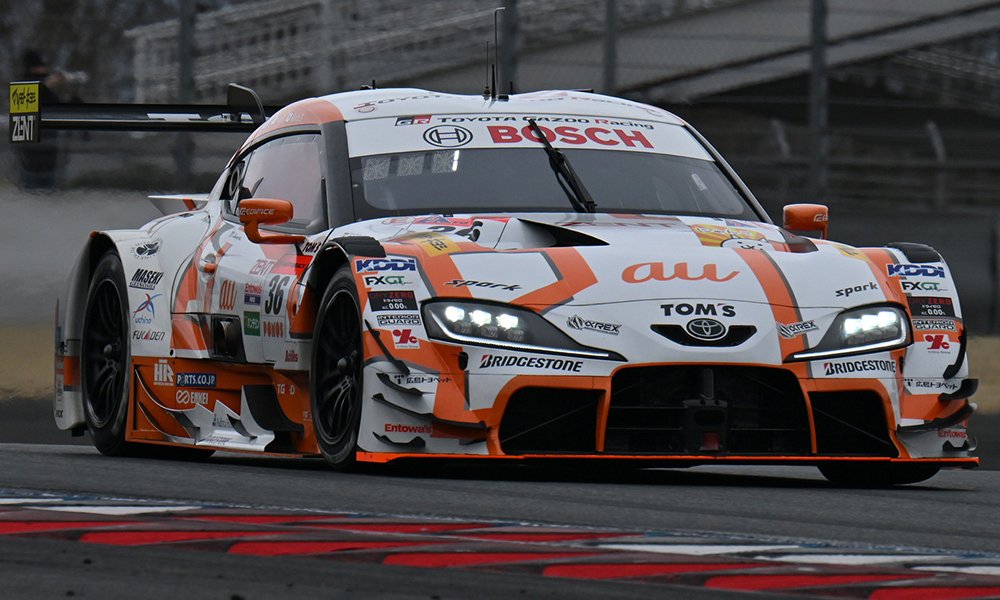
Photo: SUPER GT
Toyota driver Kenta Yamashita believes SUPER GT’s new handicap system will make it “much harder” for TOM’S in this year’s title race, describing the system of pit stop penalties as a “huge” disadvantage for the team.
In February, SUPER GT revealed an overhaul of the way success handicaps in the GT500 class are applied owing to the move to one engine per season, which prompted a reduction in base fuel flow levels in a bid to extend engine life.
Instead of reducing power via fuel flow restrictors across three stages, the second and third stage handicaps now take the form of refuelling rig restrictors — 21mm at Stage 2 (68-84 kg), down from the usual 25mm, and 19mm at Stage 3 (85-100 kg).
Paddock insiders say these figures have been chosen based on target penalty times of 10 and 15 seconds respectively compared to a normal length pit stop.
Last season, three of the Toyota GR Supras, the TOM’S car of Yamashita and Sho Tsuboi as well as the Rookie Racing and Cerumo entries, reached the stage three restrictor.
With straight line performance heavily impacted by the restrictors, the use of strategy and in particular a shorter pit stop was often key to cars carrying the most severe handicaps making up positions over the course of a race up until last year.
Asked for his thoughts on the new system compared to the previous one, Yamashita told Sportscar365: “My impression is that it’s a bit of a huge handicap.
“Until now, we’ve been able to gain time in the pit stops [even with a fuel flow restrictor], and now we won’t be able to do that anymore. I don’t know what it will be like, but perhaps if they didn’t do it, No. 36 would be able to win again easily!
“I think the system we’ve had until now that impacts the actual speed on-track with weight and power, I think it’s easier to understand, and there is value in pushing hard as a driver in various ways. To just add time on the pit stops isn’t great.
“There is a chance that we can be up front in qualifying, but if you don’t lead in the first stint, you’ll fall to the back when you pit, so the way of fighting is totally different.
“It will be much harder than last year. We won’t know how it is for sure until we try it in a real race situation, but imagining a 10-second pit penalty, that seems tough.”
However, Yamashita acknowledged that the cancellation of the Sepang round, confirmed earlier this month, and the reduction of the calendar to seven races only could mitigate some of the impact of the new handicap system.
“The importance of every round has increased, but for us, the period of time where we will have a heavy handicap is shorter, so I think it works in our favor,” he said.
Yamashita and Tsuboi got their quest to earn TOM’S a fourth consecutive GT500 crown off to a strong start this month at Okayama, and therefore head into this weekend’s Fuji Golden Week round with the maximum 40 kg of success weight.
Despite the handicap, Yamashita expressed confidence about fighting for back-to-back wins, referencing the fact it is currently forecast to rain on Monday.
“Last year, with the same handicap of 40 kg we were just one step away from the win, so this year we are aiming to try and win again,” he said.
“There appears to be some chance of rain, and I think in this kind of unstable conditions we we can even show our strength even more.”



WeatherTech Championship
Watch NBC’s WeatherTech Championship Season Review

Lamborghini Super Trofeo
Season-Long Titles to be Settled Ahead of World Finals in Monza

WeatherTech Championship
TDS Returns to Two-Car LMP2 Effort in 2027

Michelin Pilot Challenge
IMSA Shifts Pilot Challenge Testing Off 2027 Roar Weekend

GT World Challenge Europe
McLeod Targeting Next Step After First Mustang GT3 Test

GT World Challenge Europe
SRO GT Academy Winner Hartling Earns GetSpeed Drive

Mustang Challenge Global Inv.
Mustang Challenge Global Invitational Launched for 2027

Pirelli GT4 America
Muniz: “Feels So Good” to Earn First Championship With Ford


WeatherTech Championship
13 Autosport Commits to GTD Return With Corvette

Intercontinental GT Challenge
Fleming: Second Overall “Unbelievable” for Archangel

WeatherTech Championship
Watch NBC’s WeatherTech Championship Season Review

WeatherTech Championship
IMSA Endurance Hour Podcast: Ep. 40: Foley, Auberlen & More

FIA WEC
Watch Highlights of 6H Barcelona