Photo: Mike Levitt/IMSA
Heart of Racing team principal Ian James has called for IMSA to implement driver compensation ballast, which would give a “fair chance” to teams with heavier drivers in its lineups.
The measure, which was introduced in the FIA World Endurance Championship last year, and has been in use in nearly all forms of motorsports around the world, takes an average weight of the drivers in each car.
James claims that there’s routinely at least a 20 kg (44-pound) swing in qualifying in the GTP class between the lightest and heaviest driver, which the Arizona-based Briton says could lead up to a half-second difference in lap time.
“You see how close the cars were at Le Mans, especially in qualifying, having all the drivers with identical weights is a real key to that,” he told Sportscar365. “I would like to see it in IMSA.
“To me, we’re in an era of equality and giving everybody a fair chance. That should be that’s taken out of the equation in terms of advantage or disadvantage.
“It’s very easy to do. The technical department works so hard to get the right performance parameters of the cars and all that, but then you have a driver that’s 25 kgs [heavier].
“We’ve looked at the numbers and there’s a 25-30 kg difference between some of the drivers in GTP and just imagine what that does to the performance.”
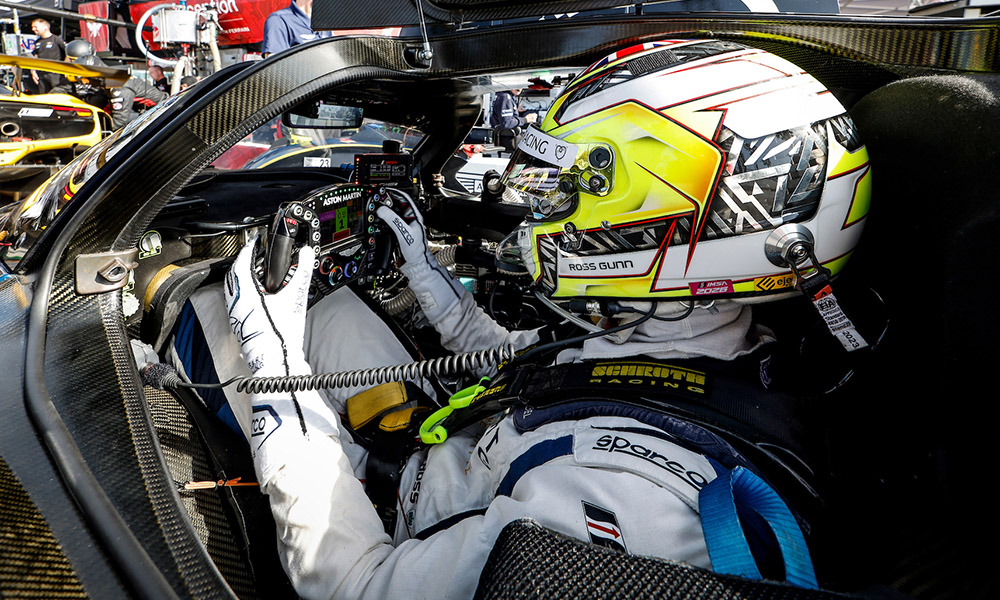
James pointed out his two full season drivers in the No. 23 Aston Martin Valkyrie, Ross Gunn and Roman De Angelis, which are both on the heavier side due to their height, compared to the likes of smaller-framed drivers such as Louis Deletraz and Dries Vanthoor.
“[Ross and Roman] are on the heavier side; they have zero body fat,” said James. “They’re on the point that if they lose any more weight, they’d be ill.
“Should we be trying to push them to do that, to be competitive? No, we shouldn’t.
“Especially in qualifying, you put a driver in that’s in the low 60 kgs against someone who’s in the mid-80s, we know how powerful 20 kgs in one of those cars.”
The WEC, for instance, measures the weight of each fully equipped driver and their seat insert, divided by three, to establish an average, with a reference weight established.
The difference between the total averaged weight of each crew and the reference weight would then dictate whether the car would receive or lose ballast, if over or under the reference weight.
Ballast would also be put in place for qualifying depending on the driver selected by the team for the specific session.
“An [Antonio] Fuoco, a Dries [Vanthoor] or a [Charles] Milesi… These guys are phenomenal drivers and they’ve actually proved [in WEC] when their weight is equalled out, they’re still at the front,” said James.
“But especially in IMSA, qualifying is so important. At some tracks, 20 kgs is as much as half-a-second a lap.
“I think we’re missing something there. Even if you look at the Cadillac ranks and the different drivers that qualify there and the performance is totally different based on who drives.
“There’s [Louis] Deletraz and Jordan Taylor, and Jordan is probably the fittest guy in the paddock. It’s not for a lack of trying or wanting to be there, it’s just how you’re born.
“It’s really hard when that goes against somebody in a negative effect.”
James alluded to that a lack of average driver weight is having a direct impact in performance on track, although fell short of calling out Balance of Performance, which IMSA forbids manufacturers, teams and drivers to discuss in the media.
“I think everybody is investing a lot of money and effort into these programs,” he said. “That’s really one of the areas which hasn’t been addressed yet.
“IMSA is the only championship in the world that doesn’t do that I believe. SRO does, DTM does, NASCAR does, MotoGP does, Formula 1 does, WEC does, British GT does.
“You’d have to dig a long way to find another championship that doesn’t.
“Maybe that’s an area they could improve on because it’s unfair on individuals if they don’t have a driver that’s not a certain size.
“Likewise for a team. I’m not going to change my drivers based on that. Hopefully it gets looked at.”



Lamborghini Super Trofeo NA
Lind, Bamber Take Final Poles of the Season at Monza


Michelin Pilot Challenge
DEForce Racing Set for TCR Debut With CUPRA

Lamborghini Super Trofeo NA
Formal, Doyle Planning Pro Class Entry Next Year

Lamborghini Super Trofeo NA
Formal Fastest in Super Trofeo Practice at Monza

Mustang Challenge Global Inv.
Mustang Challenge Global Invitational Launched for 2027

WeatherTech Championship
13 Autosport Commits to GTD Return With Corvette


Porsche Carrera Cup NA
Entries Open for 2027 Carrera Cup Season

FIA GT World Cup
BMW Reveals Three-Car Lineup for Macau

WeatherTech Championship
Watch NBC’s WeatherTech Championship Season Review

WeatherTech Championship
IMSA Endurance Hour Podcast: Ep. 40: Foley, Auberlen & More