Photo: Brandon Badraoui/IMSA
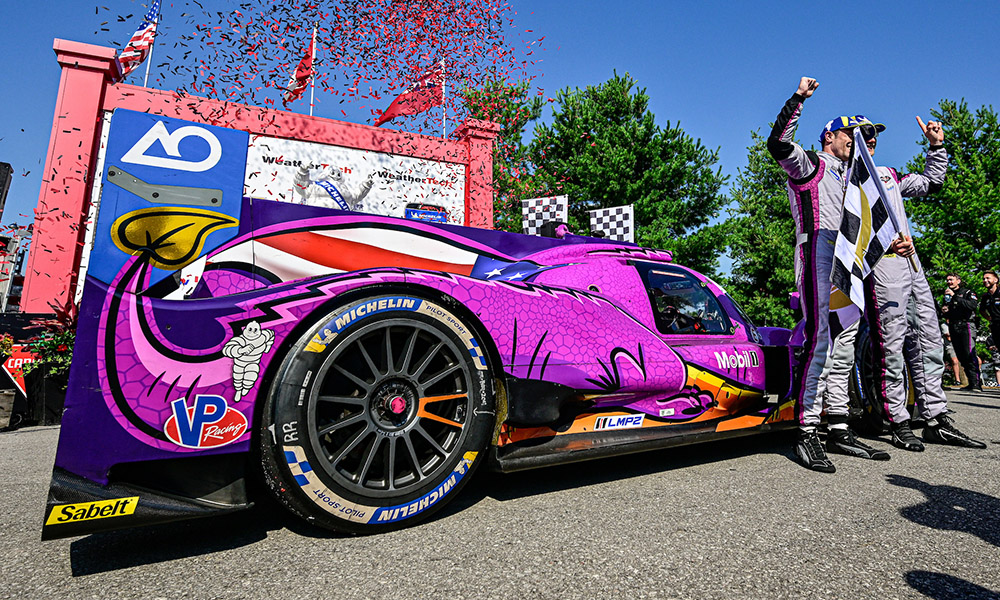
Before LMP2 takes center stage for IMSA at Canadian Tire Motorsport Park for the third consecutive year, it’s worth looking back at a part of the category’s history.
Michelin’s current IMSA tire for the class traces its roots to an open-competition era in international LMP2 racing, when tire manufacturers were developing directly against one another.
“When we’re in a tire war against a competitor, we’re throwing our best stuff at it,” said Hans Emmel, IMSA WeatherTech Series Manager – GTP & LMP2.
“Our best designers, our best material designers, obviously everything we can put into the tire. And that’s a tire that’s still being used in LMP2 today, still at a very high level.”
Michelin’s LMP2 racing slick is not commercially available like tires used in other IMSA categories such as GTD, GS and TCR.
It’s made only for LMP2 cars competing in IMSA, and this weekend, it will be asked to perform at one of the most challenging tracks on the schedule.
“CTMP, outside of Daytona, is probably the highest loaded track that the LMP2 cars will see,” Emmel said. “I mean, you’re talking about some really serious corner loading around the track, which is really hard on the tires, both in terms of endurance and also tire wear.”
With tire allocations being reduced over the years as part of Michelin and IMSA’s sustainability efforts, strategy becomes even more important.
For example, when LMP2 raced at CTMP in 2019, teams had an event allocation of ten sets. This weekend, teams will have an allocation of six sets.
“So, you can use as much as you want in practice, but you must only use a subset of four sets for the quali and the race,” Emmel said.
“It’s interesting strategically, is how much effort you put into nailing the setup and going through a few sets of tires in practice, or reserving more tires for the race so that you can throw more tires at it during the race.”
In LMP2, tire performance matters for every driver in the lineup.
The class includes FIA Bronze-rated drivers, but the goal is the same whether the driver is Bronze, Gold or Platinum: give them a tire they can trust.
For Michelin, that means building a tire that warms up quickly, gives the driver a clear feel for its peak grip, stays consistent over a stint and provides what engineers call combined grip.
“The driver going into a corner while still on the brakes is able to put in some turn-in, some lateral load on the front and get a little bit of change of direction,” Emmel said. “So you’ve got both longitudinal and lateral forces going in. That’s called combined grip.”
That level of tire performance matters in a class where the competition continues to rise, from the strength of the teams to the level of driver skill.
“You think of United Autosports, Inter Europol, who’s winning at Le Mans, AO Racing coming in and winning,” Emmel said.
“And the level of the Bronze drivers, you know, the level of the pro drivers that they’re bringing in to close, it just keeps getting better and better every year.”



WeatherTech Championship
BMW Announces Eng’s Departure From Works Roster

FIA GT World Cup
Tigani Reveals Special 7-Eleven Livery for Macau


WeatherTech Championship
Watch NBC’s WeatherTech Championship Season Review

Lamborghini Super Trofeo
Season-Long Titles to be Settled Ahead of World Finals in Monza

WeatherTech Championship
TDS Returns to Two-Car LMP2 Effort in 2027

Mustang Challenge Global Inv.
Mustang Challenge Global Invitational Launched for 2027

Pirelli GT4 America
Muniz: “Feels So Good” to Earn First Championship With Ford


WeatherTech Championship
13 Autosport Commits to GTD Return With Corvette

Intercontinental GT Challenge
Fleming: Second Overall “Unbelievable” for Archangel

WeatherTech Championship
Watch NBC’s WeatherTech Championship Season Review

WeatherTech Championship
IMSA Endurance Hour Podcast: Ep. 40: Foley, Auberlen & More

FIA WEC
Watch Highlights of 6H Barcelona