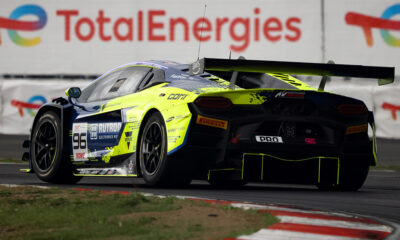
Photo: Genesis
Stephane Ratel has issued a stark warning to GT3 manufacturers that the category is in peril if current developments towards more extreme machinery continue.
SRO Motorsports Group boss Ratel, who launched GT3 20 years ago with the FIA, has warned against the trend towards machinery developed first for the race track and then homologated for the road.
He shied away from naming manufacturers, though he was clearly referencing Toyota’s GR GT3 launched late last year, the Mercedes-AMG currently known as the Concept AMG GT Track Sport and the Genesis GT3 Concept unveiled earlier this month at the 24 Hours of Le Mans.
“I had a very important meeting yesterday with the ten manufacturers involved in GT3 where I told them that if they want to continue like this we are going straight to the wall,” Ratel said on Saturday ahead of the CrowdStrike 24 Hours of Spa.
“It is very clear that if stakeholders, the FIA and the manufacturers, want to go that way, I would propose to the next GT Commission to rename it GT1, because it is GT1.
“If you design a car to the maximum of the regulations and you homologate it for the road, this is GT1.
“GT3 is taking a road car, and then adapting it for racing.”
Ratel drew comparison with cars such as the Porsche 911 GT1 and the Mercedes CLK-GTR of the following year, which sparked an arms race in the second half of the 1990s that resulted in the death of the original GT1 class.
He argued that the new breed of car will drive up costs, both in terms of the purchase price and running costs.
Ratel suggested the highest profile series incorporating GT3 machinery, such as the FIA World Endurance Championship and SRO’s GT World Challenge Europe powered by AWS, could potentially absorb increased costs, but the lower level championships that underpin the success of GT3 would not be able to do so.
He pointed out that the volume of racing cars that each manufacturer can sell is vital to its health.
Ratel suggested that there needed to be some kind of arbiter or referee to decide what constitutes “a GT sports car” suitable for GT3.
“Look at history: when we had the Ferrari 550 Maranello GTS against the Aston Martin DBR9 and the Chevrolet Corvette C6.R, and then a Maserati MC12 came, a 10-year-old could see the difference,” he said of the later GT1 category in the 2000s.
“You need to have a clear mind and say, ‘This is too radical, you go back to the drawingboard and come back with a car that fits the spirit of the regulations.’”
His concerns about the future of GT3 contrasted with comments Ratel made earlier this year saying he was not overly worried about the change in direction adopted by manufacturers.
Ratel conceded that the trend towards more extreme cars was being driven by hybridization.
“The road cars are getting bigger and heavier, and therefore it is more difficult for some manufacturers to make them into efficient race cars,” he explained.
“Naturally we will see manufacturers doing specials; I think that is a trend we can’t entirely reverse.
“But then we need a referee who says, ‘Okay you start from a bit of a special, but the special needs to have the look and the feel of a road-going GT car.’ That is the concept.”
Ratel suggested that it was time to rethink the GT3 category for the future.
“For GT3 we should really redefine everything and propose an evolution, a clear reassessment of what the category should be,” he said.
He drew a parallel with the announcement from the WEC organizers the ACO and the FIA at Le Mans this year laying down the guidelines for developments in the Hypercar category for 2030 and suggested a similar timeline for GT3.
Other concerns were highlighted by Ratel on race morning at the 24H Spa.
He suggested that what he terms “the four pillars” underpinning the success of GT3 are not being universally respected.
Those foundation stones are the use of true production cars as the basis of GT3 racing machinery, the participation of exclusive brands, cost-effectiveness and the strong customer support provided by the manufacturers.
Ratel said he named and shamed manufacturers in his meeting on Friday for not respecting his pillars.
“I have been straightforward with them, and said, ‘Because of you, this happened and because of you, that has happened,’” he added.



Lamborghini Super Trofeo
Season-Long Titles to be Settled Ahead of World Finals in Monza

WeatherTech Championship
TDS Returns to Two-Car LMP2 Effort in 2027

Michelin Pilot Challenge
IMSA Shifts Pilot Challenge Testing Off 2027 Roar Weekend

GT World Challenge Europe
McLeod Targeting Next Step After First Mustang GT3 Test

GT World Challenge Europe
SRO GT Academy Winner Hartling Earns GetSpeed Drive

WeatherTech Championship
IMSA Endurance Hour Podcast: Ep. 40: Foley, Auberlen & More

Mustang Challenge Global Inv.
Mustang Challenge Global Invitational Launched for 2027

Pirelli GT4 America
Muniz: “Feels So Good” to Earn First Championship With Ford


WeatherTech Championship
13 Autosport Commits to GTD Return With Corvette

Intercontinental GT Challenge
Fleming: Second Overall “Unbelievable” for Archangel

WeatherTech Championship
IMSA Endurance Hour Podcast: Ep. 40: Foley, Auberlen & More

FIA WEC
Watch Highlights of 6H Barcelona