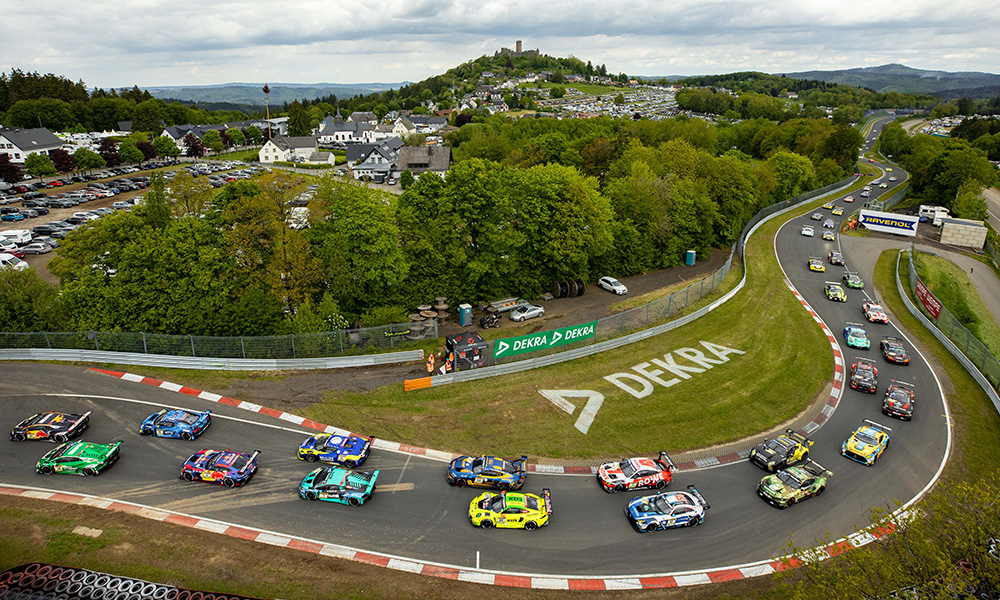
Photo: Gruppe C Photography/SRO
Stephane Ratel has reaffirmed SRO Motorsports Group’s commitment to keep the Nürburgring 24 on the Intercontinental GT Challenge calendar, amid its shift away from the globe-trotting GT3 series’ original ethos.
Last weekend’s Eifel endurance classic marked the third year the N24 has been part of IGTC, which has joined the CrowdStrike 24 Hours of Spa as a second event in Europe.
While IGTC was originally conceived as a GT3 series with five different length races on as many continents, Ratel said the shift away from that format has been made due to the significance of the Nürburgring 24 as being one of the biggest GT3 races in the world.
“Of course it’s a huge event,” Ratel told Sportscar365. “The clear ambition of IGTC was to bring the biggest GT3 races, where GT3 is an overall winner.
“That is undoubtedly one of the biggest. Ok, we drifted a bit away from the original concept of five races on five continents, which was very nice, but I think this one definitely deserves to be a part of it.
“We have also built a very friendly and constructive relationship with the promoter, the ADAC, and it works well. It’s good for the sport.
“Now I really think with Bathurst, Spa, Nürburgring and Suzuka, we have a very, very strong [product].
“It’s true that America is still the weakest part of it. Indianapolis is a great name but to build a crowd is difficult as we all know.
“Even if we would manage to build a little crowd, it would still look like nobody’s [there].
“It’s not the easiest. But [the Nürburgring 24] is definitely a very, very good event, especially now with the ‘Max Mania’, it’s really spectacular.”
Ratel said they have no current plans to replace the Indianapolis 8 Hour presented by AWS on the IGTC calendar, despite it arguably not being the highest-profile GT3 endurance race
“For the moment we’re at Indy,” said Ratel. “We also have a good relation with the circuit. If you look at Laguna (Seca, which served as the U.S. IGTC venue from 2017-19) we really had difficulties of having a grid.
“Indianapolis, for the American teams somehow, it means something, which is good. We stay and we hope that the fact we have more manufacturers joining.
“Thanks to Abi [Hay, IGTC series director], who has done a really fantastic job. When she started we were down to three. Then it went to four and now we have six.
“Our ambition is to have everybody. Somehow, if you’re in GT racing, you should do the big ones. And if you bring the big ones together, that’s IGTC.
“Somehow, we should have every GT3 manufacturer in the IGTC. It would be logical.”
Ratel said there are no plans to expand the IGTC calendar next year, either, indicating that the 2027 schedule will likely be unchanged for the third consecutive year.
“If one day we have ten or 11 manufacturers, maybe we will say, ‘OK, we’ll discuss with them to do an extra round. But I think at the moment it’s good,” he added.
A return to Kyalami, or potential event in South America in the future, would be dependent on increased manufacturer participation.
That’s because both of those locations don’t currently have an established grid of local GT3 cars to lean on, which has been the strength of the series in Europe, Asia and the U.S.
He said: “If you don’t have this base grid, you have two solutions: Either you will need a lot of money to support the teams and pay their transport and something like we did with Jeddah, which was GT World Challenge but it could have been IGTC.
“We say to the teams, ‘We support your transport, we give you a check, start money, everything and you can do it.’
“Or you end up with 12 cars on the grid, which is what unfortunately happened in the end in Kyalami.
“It wasn’t even entirely fair because at the moment we were stopped by COVID, we had a good grid. But if we were to really have ten manufacturers, all of them with really committed with two cars, let’s say, is 20 cars.
“That’s enough to do a race even if you don’t have [local entries]. But we’re not there yet.”
Ratel Explains Difference Between IGTC, Global GTWC
While SRO has been able to attract ten GT3 brands for its global GT World Challenge campaign, Ratel stressed the difference comes in level of manufacturer support.
“GT World Challenge is purely customer racing,” he explained. “You have all your teams scoring points around the world.
“This year it’s well disputed, more than ever. You don’t need factory involvement, where in IGTC, somehow, you need to put strength behind your teams at some point. Not always everywhere but at some point.
“In GT World Challenge globally, I think it’s also the manufacturers, the ones that really on paper, the ones that don’t have a chance because they don’t have enough cars running, they do it a bit like as a proof of support to what SRO is doing for GT3 racing globally.
“Most of them enter because yes, they are in the SRO world. They want to be part of the SRO family, whereas in IGTC, it’s a more of a [financial] commitment.”




GT World Challenge America
Lahlouh “Determined” to Return Stronger After Early End to Year

McLaren Trophy America
Forte Looking to “Finish the Job” Amid Strong Second Season

Intercontinental GT Challenge
Palou Aiming to Support Stolz, Mercedes-AMG’s IGTC Title Bid


Toyota GR Cup NA
Watch Full-Length Replays of Rounds 11 & 12 at Barber

WeatherTech Championship
Factory Mustangs to Run 125th Anniversary ‘Sweepstakes’ Livery

Toyota GR Cup NA
Fletcher Keeps Title Hopes Alive With Sunday Barber Win

Intercontinental GT Challenge
Palou Joins Lone Star Racing for Indy 8H Return

WeatherTech Championship
Both Specs of Porsche 963s Get Weight Breaks for Petit Le Mans

Asian Le Mans Series
Two Ferrari 499Ps First Confirmed Hypercar Entries

Toyota GR Cup NA
Watch Full-Length Replays of Rounds 11 & 12 at Barber

Porsche Carrera Cup NA
Watch Full-Length Replays of Rounds 13 & 14 at Road Atlanta

Michelin Pilot Challenge
Watch the Full-Length Replay of Fox Factory 120

WeatherTech Championship
Watch Extended Highlights of Motul Petit Le Mans

WeatherTech Championship
Watch IMSA’s ‘Win the Weekend’ S4 E7: Indianapolis