Photo: Brian Cleary/SRO
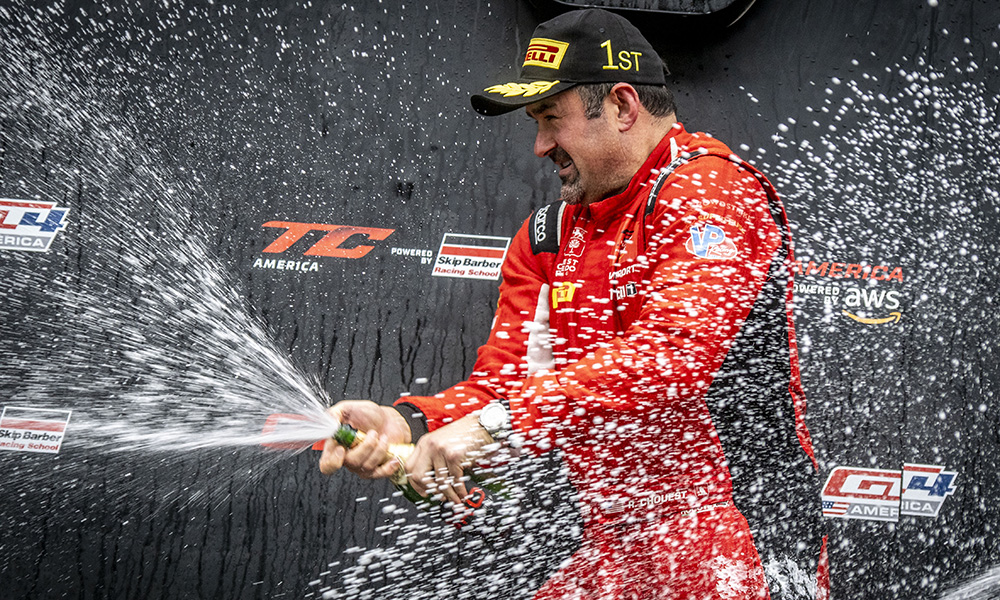
Ross Chouest has explained his decision to focus on GT America powered by AWS this year, having elected to forgo participating in GT World Challenge America powered by AWS races due to the series’ change to a single three-hour race.
The former GT America GT4 class champion stepped up to GT3 competition last year with a pair of Chevrolet Corvette Z06 GT3.Rs, running in both GTWC America and GT America.
While his Chouest Povoledo Racing Corvette is still entered in GTWC America events, he and co-driver Aaron Povoledo utilize the practice sessions for setup work and additional track time for the FIA Bronze-rated driver.
“I didn’t really like the change to the three-hour races,” Chouest told Sportscar365. “It seems to maybe be split; some people may prefer it, some people don’t like it as much.
“For me, when Aaron and I first started racing this series, one of the main appeals was a lot of track time an a lot of races.
“I understand, changing it to a three-hour race, is essentially the same track time, or similar track time.
“But the amount of races, if I look back through the year, it seems like a lot of silly stuff happens in races where something happens and it kind of ruins your race.
“From that perspective, it didn’t have the same value proposition for me as it did having two races vs. one race per weekend.
“In the previous years, I liked the variety of having four races each weekend. There was a lot of opportunities to have success and podiums.
“I generally like that format of having two races [per series]. That’s the most appealing to me.”
Chouest noted several incidents during his dual series campaign last year that would have resulted in the end of an entire weekend this year if he’d be only entered in a single GTWC America race.
“Looking back to Sebring last year, my elbow hit the pit speed limiter button during the driver change and it screwed up our race,” he said. “There’d be a lot of time and effort and money all for just one race.
“I don’t like putting all the eggs in one basket.”
Chouest said it’s “too early to say” if his focus on GT America this year will make him a better driver.
“I guess the weekends are a little more concise now compared to previous years where starting on Thursday,” he said. “I didn’t know how I’d like that but I think I do like the more concise weekends.
“Some of these races, especially Sonoma and the other ones, you’d be away from home for almost a week. I like the new Friday-Saturday-Sunday format vs. the Thursday-Sunday from last year.”
While GT America features a number of new drivers this year, Chouest said several are familiar faces from his Ferrari Challenge days.
“Jason McCarthy and Dave Musial Sr., are two former teammates of mine so I know them well,” he said. “I look forward to racing against them.
“They don’t have a lot of experience with GT3 yet but I’m sure they will come up to speed pretty quickly.
“Maybe the drivers that have less GT3 experience, I might initially have a little advantage, but everyone are good, experienced drivers.”
Povoledo Sends Warning on Increased Costs for GT3 Racing
Team principal Povoledo, meanwhile, has warned that increased costs, particularly in the North American market, could already be reaching a ceiling point for gentlemen drivers.
“I think there’s a tipping point where it doesn’t matter, you could be God and have all the money in the world, but how much money is it worth to have fun?” asked Povoledo.
“There’s a ceiling. You’ll always have the handful of guys that want the Rolex watch. They’ll spend whatever it takes to do it to tick that box.
“But that’s a handful of people. I think your average person is like, ‘Great, this is my hobby. This is fun. I love it. But at this level, that’s cool.’
“But it’s now crept up [higher] and now it’s not worth it, and I think we’re going to see more and more of that.”
Povoledo believes if the European market had similar costs to GT3 racing than currently seen in the U.S., GT World Challenge Europe powered by AWS, for example, wouldn’t be at capacity grids.
“Everything is cheaper in Europe,” he said. “If Europe was 35 percent more expensive [than America] they’d be struggling to fill their grids.
“Cost really matters.”



WeatherTech Championship
IMSA Honors Season’s Best at Night of Champions

Intercontinental GT Challenge
13 Autosport Set for Bathurst 12H Debut; N24 Plans in Works


WeatherTech Championship
Road Atlanta Post-Race Notebook

WeatherTech Championship
Strides Made Across 70,000 Miles of GTP Competition

Lamborghini Super Trofeo Europe
Salonen, Tuomaala Take First Win in Sole Barcelona Race


WeatherTech Championship
Factory Mustangs to Run 125th Anniversary ‘Sweepstakes’ Livery

GT World Challenge America
Sargent Tops Opening Practice in Buc-ee’s Porsche at Barber

Toyota GR Cup NA
Fletcher Keeps Title Hopes Alive With Sunday Barber Win

WeatherTech Championship
Both Specs of Porsche 963s Get Weight Breaks for Petit Le Mans

Intercontinental GT Challenge
Palou Joins Lone Star Racing for Indy 8H Return

Michelin Pilot Challenge
Watch the Full-Length Replay of Fox Factory 120

WeatherTech Championship
Watch Extended Highlights of Motul Petit Le Mans

WeatherTech Championship
Watch IMSA’s ‘Win the Weekend’ S4 E7: Indianapolis

WeatherTech Championship
IMSA Endurance Hour Podcast: Ep. 39: John Doonan & More

Michelin Pilot Challenge
‘Like Father, Like Daughter’ Ep. 3: A Homecoming