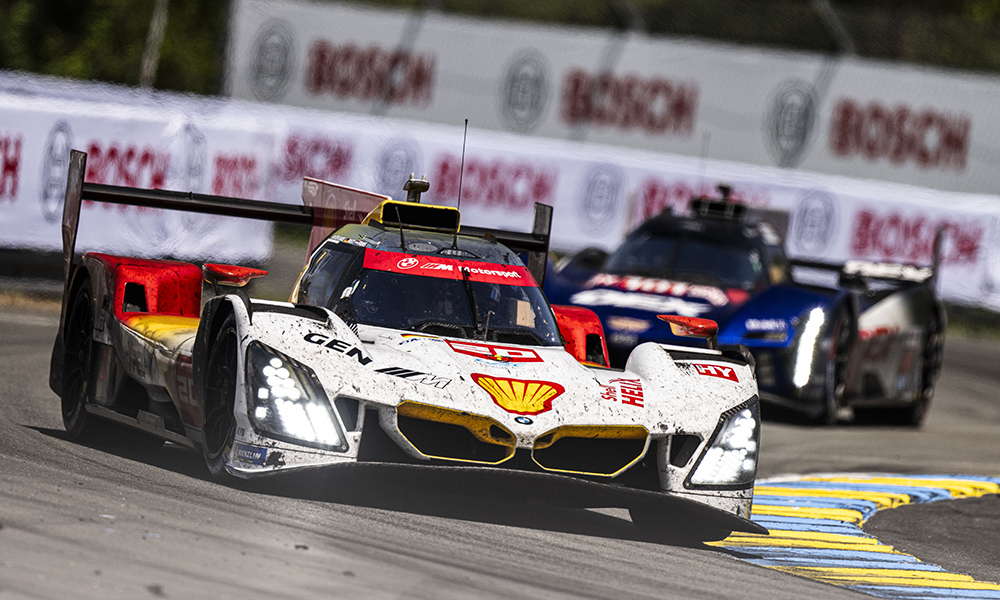
Photo: Charly Lopez/DPPI
BMW Team WRT driver Robin Frijns said the last safety car period in the 24 Hours of Le Mans was “painful” after having built up a considerable lead, particularly to the Toyota TR010 Hybrids, that ended up erasing its chances of victory.
Frijns and co-drivers Sheldon van der Linde and Rene Rast scored a runner-up finish, giving BMW its first overall podium result in the French endurance classic since the brand’s last win at Le Mans in 1999.
However, it came in a race that saw the No. 20 BMW M Hybrid V8 lead the second-most number of laps in Hypercar and appeared to be in prime position for a historic triumph.
However, a sizable accident for Ayhancan Guven in the No. 91 Manthey Porsche 911 GT3 R Evo with just under six hours to go erased Frijns’ 30-second lead over the No. 12 Hertz Team JOTA Cadillac V-Series.R of Norman Nato and a 45-second margin on third-placed Kamui Kobayashi at the time.
Kobayashi and co-drivers Mike Conway and Nyck de Vries went on to claim Toyota’s sixth overall win in the race after capitalizing on the race’s neutralization.
When asked for his thoughts on the safety car period, Frijns said: “Yeah, painful.
“The [No. 8] Toyota boxed, or had an issue an hour before that, something with the brakes. I wouldn’t say they were out of contention then but they dropped.
“We were a bit out of reach at that moment but then they were back in the game and we knew the Toyota was very strong.
“They showed good pace, especially in the beginning of the race when they undercut people. That was a big disappointment for us.”
Van der Linde added: “The safety car is where it all went wrong for us. We had the lead at that point, we had track position and then at some point we lost the lead because we had to fill up the most energy.
“It’s so difficult to overtake at Le Mans. Especially when the Toyota has a pace like that, you need to take so much risk in traffic and we also needed to look after our car because if you cut the chicanes in a wrong way, you damage the car, you damage the floor and there’s a possibility of you not finishing the the race at all.”
Frijns, who completed a daring move on the outside the No. 8 car of Sebastien Buemi in the Porsche Curves for second place with 47 minutes to go, said he wasn’t surprised by the pace of the two Toyotas, which started 14th and 15th on the grid.
“I think Toyota was always on the radar because they showed good race pace,” he said. “Qualifying is one thing. Obviously you want to qualify in the front and it’s always nice to start from pole.
“But in the end of the day, it’s a 24-hour race. After two hours, everything is different again.”
WRT team principal Vincent Vosse told reporters post-race that they put “everything on the table” to go for the win.
Frijns crossed the line just 10.913 seconds behind Kobayashi, in one of the closest finishes in race history.
“There’s nothing to regret,” said Vosse. “It was a very strong race, a faultless race from the drivers, from the team, from the car.
“Everything what we had we put it on the table.
“For the one [manufacturer] who was not sure during Free Practice that we were putting everything on the table, now they know.
“We were just, as I always said before, you have to be at the right place at the right time.
“During the two safety cars, we were quite unlucky. But we could not dream of a more perfect race.”
Roos: No. 20 BMW Was on “Back Foot” on Two Fronts
BMW M Motorsport director Andreas Roos, meanwhile, revealed the No. 20 crew were on the “back foot” on two fronts towards the end of the race, in also having to alter its energy strategy.
He explained: “At the end, shortly before the safety car, we had quite an advantage in track position, where we were in front, but we had a small disadvantage in energy.
“The safety car basically took the track position advantage completely to zero and we only had the disadvantage in energy.
“From this moment, we were clearly on the back foot. Then we had to see we come back into the same rhythm of the others in terms of energy.
“So you start to do 13-lap stints and so on.”
When asked if he thought they would have won had the safety car not have come out, Roos replied: “No, I would not say because that’s too much.
“It would have for sure brought us in a different spot, in a different situation. But you can never say because of this we would have won. This I would never say.”
Both van der Linde and Rast, meanwhile, were left with mixed emotions after helping take the German manufacturer to its second podium finish in a 24-hour race this year, following their third-place result in January’s Rolex 24 at Daytona that also included Frijns.
“I don’t know whether to smile or cry,” said van der Linde. “If you really look at the positives, it was an incredible milestone for the program and I think it’s important for us at BMW to show that we’re not only strong in one race but consistently up there and scoring results.”
Rast added: “It’s racing, it’s Le Mans. Anything can happen in Le Mans as we know. Sometimes you’re lucky and sometimes you’re unlucky.
“Le Mans chooses the winner. We’ve often heard that and it’s true.”



Porsche Carrera Cup Asia
Joint Carrera Cup Asia/Japan Fuji Round on 2027 Calendars

Intercontinental GT Challenge
Indianapolis Thursday Notebook

Intercontinental GT Challenge
Spinelli Quickest in Free Practice at The Brickyard

McLaren Trophy America
James, Webb Close In On Pro-Am Title With Indy Race 1 Win

Pirelli GT4 America
Leist Leads Way in Opening Practice at Indianapolis


Intercontinental GT Challenge
Palou Joins Lone Star Racing for Indy 8H Return

Asian Le Mans Series
Two Ferrari 499Ps First Confirmed Hypercar Entries

Intercontinental GT Challenge
KRC Eyes Full IGTC Season; Confirms Macau Return


Asian Le Mans Series
Two Hypercars on 47-Car Full Season Entry List


WeatherTech Championship
Watch the Full-Length Replay of Motul Petit Le Mans

Toyota GR Cup NA
Watch Full-Length Replays of Rounds 11 & 12 at Barber

Porsche Carrera Cup NA
Watch Full-Length Replays of Rounds 13 & 14 at Road Atlanta

Michelin Pilot Challenge
Watch the Full-Length Replay of Fox Factory 120

WeatherTech Championship
Watch Extended Highlights of Motul Petit Le Mans