Photo: Charly López/DPPI
Current and future manufacturers involved in top-class prototype competition in either or both the FIA World Endurance Championship and IMSA WeatherTech SportsCar Championship have largely praised the 2030 regulations framework that was recently announced.
Confirmed at the annual ACO press conference in Le Mans earlier this month, the foundations of the ruleset are still in draft form and not expected to go to the FIA World Motor Sport Council for formal approval until at least the end of this year.
However, when polling more than a half-dozen OEMs, nearly all of them, aside from Toyota, were left upbeat on the future of the converged, single technical set of regulations, compared to the current divide between LMH and LMDh-based machinery.
“For me, it goes in the right direction,” BMW M Motorsport director Andreas Roos told Sportscar365.
“We needed one technical regulation for the future that we have a real convergence that we develop the cars under the same regulations and help us there to get everything closer together.
“I think the framework itself is exactly what we need and now it’s up to the technical working groups and the people defining the individual parts of this technical regulations.
“To also have the costs under control and see that we have a sustainable regulation for the future that endurance racing can continue for a long time.”
The proposed regs allow manufacturers to build cars similar to the current LMDh regulations, featuring a chassis from one of four licensed constructors and opt for a designated off-the-shelf hybrid system, or develop the entire car themselves, although it must conform to the same chassis rules and power limits as the other.
This marks a significant departure from the current LMH regs, which permit four-wheel drive cars with custom-designed front axle-mounted hybrids, as well as more design freedom than the current LMDh regulations.
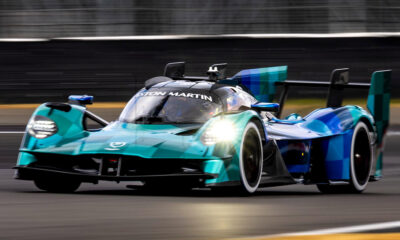
While Ferrari declined to comment on the regulations when reached by Sportscar365, fellow LMH brands Aston Martin and Peugeot are upbeat on the prospects, even if it means creating all-new cars.
“We are fully supportive of the new regulations that the FIA, ACO and IMSA have put in place, but it will be a new platform for us, so we have to look at the technical requirements,” said Aston Martin Head of Endurance Motorsport Adam Carter.
“But we [would] love to be part of it beyond 2030. It was a great announcement, but we also need to see more of the detail so we can come up with a strategy and ensure we capture the spirit of Aston Martin within the regulations.”
Head of Stellantis Motorsport Olivier Jansonnie added: “Obviously, all the manufacturers have a different opinion. The supply model is good, that we can achieve this flexibility [of building our own car].”
Both McLaren and Ford, which will join the WEC Hypercar grid next year with LMDh-based cars, have given their vote of approval as well.
“We’ve come in with the [LMDh] set of regulations and we very much believe that strikes a really nice balance for the future,” McLaren Endurance executive director James Barclay told Sportscar365.
“You need to be very careful about not creating a category where it’s defined purely by the size of the budget you have.
“That’s very important to us and the direction we see things going in is about keeping the core ingredients that have worked to this date but also making sure we really keep an eye on not accelerating costs that don’t necessarily add to the show.”
Ford Racing global director Mark Rushbrook added: “It’s the right framework to have that continued convergence.
“It’s working well today with what we have but I think it’s going to work even better with convergence [under] a single set of rules and bringing the cars even closer together architecturally and technically. I think that will help the racing for everybody.”
When polled on which pathway they would take should its programs continue into 2030, BMW, Ford and McLaren all would likely remain with constructor-supplied chassis and the off-the-shelf hybrids, where LMH manufacturers Aston Martin and Peugeot would have to build cars from scratch.
LMDh Upgradability, Size of Hybrid Powertrain Still Question Marks
A number of elements still either remain to be defined, or are up for debate between OEMs.
One is the upgradability for existing LMDh cars, which IMSA President John Doonan indicated would be possible, although adhering to the FIA’s new safety cell standards and prescribed underfloor and diffuser, the latter to elements that are aimed to bring all cars into a smaller aerodynamic window.
“For sure there will be updates but the goal must be that there’s as many carry over parts as possible from the former car,” said BMW’s Roos. “That would give the possibility to every [LMDh] manufacturer to continue and stay in the budgets of what we have at the moment.”
Porsche Motorsport boss Thomas Laudenbach said there “must be significant things” that could be carried over on grounds of cost.
“I would think you could carry over a certain amount,” he said. “On the other side, you have to think about if you have a chance to build a new car, you might do it because from what you learned.
“From what I would expect is that you don’t have to do everything from scratch… I don’t think somebody competing now needs to start from a white sheet of paper.”
Roos, meanwhile, suggests slightly increasing the size of the currently Bosch-supplied electric motor and battery from Fortescue Zero (formerly Williams Advanced Engineering).
Electric motor and battery capacities were not disclosed at the announcement.
“I think this has to be investigated because when we started developing the system for the current Hypercars, it was already 2021-22,” said Roos. “Since then, especially on the hybrid systems’ side, a lot of things have moved on in the road cars.
“It’s good to have a look at it, maybe if there’s some possibilities where we can do the next step. But for me it’s not a ‘must’ from the pure racing side.”
Jansonnie added: “We have two [platforms] now. It’s very likely we’re going to end up in between [in terms of hybrid power]. The question is where [exactly] do we end up in between?
“They put cost at the very start of their prefixes, which we believe is very good. It’s very important to keep costs under control.
“Now it needs to be analyzed where we can put the technology while keeping costs completely under control.
“There’s probably room to increase the amount of electrical energy compared to the current LMDh.”
Mixed Feelings on Evo Joker Elimination
Laudenbach, who said the new regs will “play a role” in Porsche’s possible WEC Hypercar return in 2030, meanwhile, believes Evo jokers should remain, which counters the framework presented earlier this month that stated there would be no “performance evolution” allowed for a minimum of five years, with only safety or reliability updates permitted, or a “demonstrated significant deficit of performance.”
“This is hopefully something that we will still discuss because it’s well appreciated from a perspective of cost control,” he said. “On the other side, I have to say, that the development work we did after the initial development of the car was not that much. It was not the budget factor.
“Let’s say you build a car and you figure out that the first few races that you probably don’t have the fastest package. So then you have to rely 100 percent on the sanctioning bodies to get it right.
“I think that’s probably where some thoughts have to be put in. Because for a manufacturer, you want to have the possibility to improve things if you didn’t get things right.”
Jansonnie said: “They should have done this (eliminate jokers) ten years ago. We keep on pushing for that.
“This constant development on the cars, regardless of the performance on track, is not what we’re requesting. We’re requesting the other way around.
“We should [only] be able to develop your car when you cannot perform and be balanced. In that respect, the 2030 regulations are finally what we’ve been asking for many, many years.”
Laudenbach, meanwhile, has suggested taking a similar approach to MotoGP, which permits manufacturers to make updates based on race results.
“You’re only allowed to bring updates when you’re not running at front,” he said. “I think that’s not such a bad thing. It would still be in a limited and restricted way.”
Jamie Klein contributed to this report




GT World Challenge Europe
GetSpeed Mercedes-AMG Snatches Win in Portimao

FIA WEC
Barcelona Saturday Notebook

Intercontinental GT Challenge
ABT Extends Lamborghini Partnership, Temerario to N24

Mustang Challenge Global Inv.
Mustang Challenge Global Invitational Launched for 2027

GT World Challenge Europe
Six WEC Drivers Also on 61-Strong Portimao Entry List


FIA WEC
Watch WEC’s Barcelona Preview


McLaren Trophy America
Watch Full-Length Replays of Final Rounds at Indy